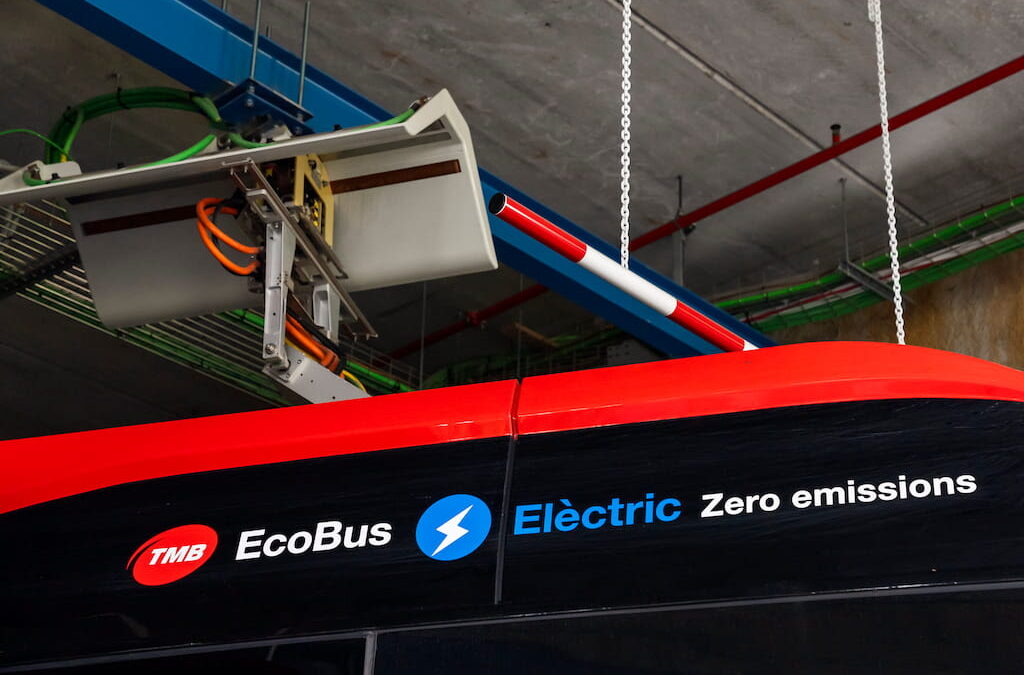
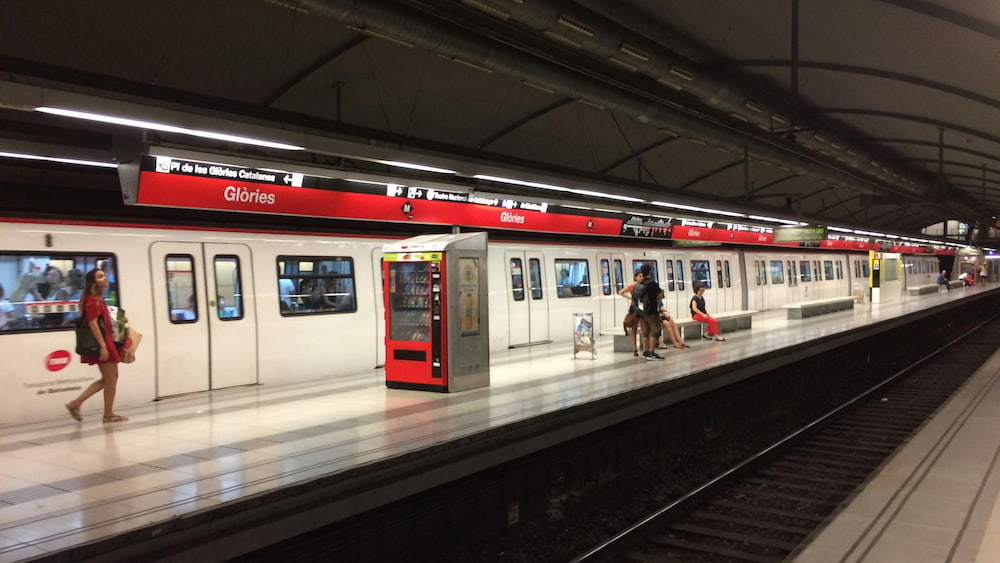
Glòries Metro Station in Barcelona operated by Transports Metropolitans de Barcelona (TMB)
A new study from CIMNE’s Innovation Unit in Transport (CENIT) researchers concludes that for every euro managed by Transports Metropolitans de Barcelona (TMB), €3.4 is returned to society through economic activity, job creation, and social and environmental benefits.
Based on 2024 data, the analysis estimates that TMB generates a total social value of €4.45 billion annually. This figure combines both economic impact and broader societal benefits linked to public transport usage in the Barcelona metropolitan area.
TMB’s activity accounts for an economic impact of €2.53 billion per year, largely generated within Catalonia. This includes direct, indirect and induced effects:
- Direct impact: Employment and wealth generated through TMB’s core operations
- Indirect impact: Economic activity generated across supply chains
- Induced impact: Additional consumption resulting from employment linked to TMB
Overall, TMB supports approximately 32,000 jobs, including 30,653 in Catalonia and 1,362 in other regions. Within the Barcelona metropolitan area alone, TMB contributes €1.78 billion, representing 1.02% of regional GDP, and supports over 25,000 jobs.
Social and environmental benefits
In addition to economic output, the study highlights significant social and environmental savings valued at €1.91 billion annually. These benefits are calculated using a modal substitution scenario, estimating how mobility patterns would change in the absence of TMB services.
Key findings include:
- Reduction of 288,700 tonnes of CO₂ emissions, equivalent to the annual energy consumption of approximately 410,000 households
- Savings of 180.2 million hours of travel time, comparable to the workload of 100,000 full-time jobs
- Improvements in air quality, noise reduction, and road safety
Without TMB, the study estimates that 67% of current users would shift to private vehicles, while only a quarter would opt for walking or cycling, significantly increasing congestion and emissions.
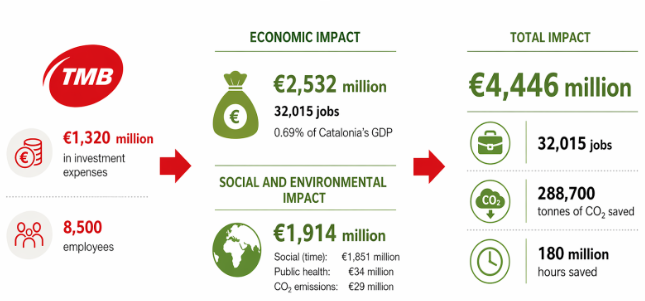
TMB generates a total social value of €4.45 billion annually, translated to multiple direct and indirect benefits for society.
A systemic impact on the metropolitan area
According to the study, TMB’s overall contribution represents more than 1% of the GDP of the Barcelona metropolitan area, underlining its role as a key public service infrastructure with wide-ranging impacts.
The analysis also models a scenario in which public transport demand increases by 1%, resulting in an additional €19.3 million in annual social and environmental savings and a reduction of approximately 400 tonnes of CO₂ emissions.
According to project manager, Genis Majoral, “This study quantifies the broader value of public transport beyond mobility itself. It shows how an integrated system like TMB contributes not only to economic activity, but also to more efficient use of time, improved public health, and reduced environmental impact.”
Beyond these impacts, the study also highlights the role of public transport in promoting equity. As Dimitrios Karamanis, transport and mobility researcher at CENIT and co-author, explains, “Public transport, and in particular TMB, plays an essential role in shaping social, economic, and mobility equality, delivering a significant positive effect across the entire metropolitan area of Barcelona.”