Digitalisation is reshaping the maritime sector, and ports are increasingly adopting advanced technologies such as artificial intelligence, IoT, and data-driven tools to improve efficiency, safety, and sustainability. In this context, digital twins are emerging as a key innovation, enabling real-time monitoring, simulation, and optimisation of port operations.
However, despite their potential, the adoption of digital twins in ports remains limited due to high implementation costs, complexity, and uncertainty around benefits. A new article by Chiara Saragani, Researcher at CIMNE’s Innovation Unit in Transport, CENIT, and co-authored with Javier Garrido and Sergi Saurí, published in the Journal of Shipping and Trade, explores how digital twin (DT) technologies can support the digital transformation of ports and enhance decision-making processes.
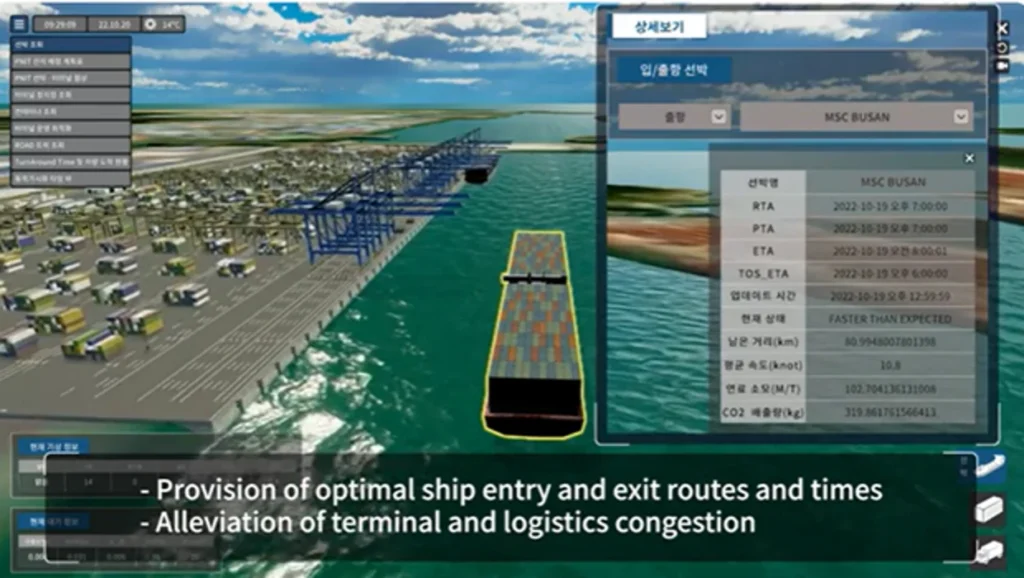
Representation of the digital twin in Busan Port Authority (BPA). Source: BPA, https://www.youtube.com/watch?v=OUXcq1tTl-c
A structured framework for decision-making
The research, titled “Digital twin adoption in port authorities: a structured framework for use case assessment“, addresses this gap by proposing a structured framework to help port authorities identify, assess, and prioritise digital twin use cases. The research is based on 77 interviews conducted at the Port of Barcelona, 12 additional interviews with international ports, and the identification of 80 potential use cases for digital twin applications.
These use cases are grouped into three categories of users: operations, support and administrative functions, and linking (external coordination and strategic roles). They are then evaluated against nine criteria covering both impact (e.g. time savings, sustainability, cross-departmental benefits) and resource requirements (e.g. cost, expertise, implementation effort).
Key insights
The findings show that most ports are still in the early stages of digital twin adoption. Among the 80 use cases, there is a strong preference for high-impact, low-resource use cases, and different departments prioritise different functionalities: operational teams focus on prediction and optimisation, administrative units emphasise monitoring and management, and linking functions prioritise coordination and strategic planning
The study also highlights the importance of aligning digital twin strategies with broader digitalisation goals and organisational needs.
Supporting the future of sustainable ports
This research contributes to ongoing efforts to support ports in their transition towards more efficient, resilient, and sustainable operations. By providing a practical decision-making framework, it helps port authorities move beyond isolated pilot projects towards more strategic and scalable digital solutions.
Chiara Saragani explains:
“Digital twins offer significant potential for ports; however, the challenge is not purely technological. The key lies in clearly identifying where value can be created and prioritising use cases that align with organisational needs and available resources. Moreover, Digital Twin solutions should not be seen as standalone technologies, but rather as enablers that deliver their full potential when integrated with other existing technologies such as 5G connectivity, IoT systems, and AI solutions.”
Saragani, C., Garrido, J. & Saurí, S. Digital twin adoption in port authorities: a structured framework for use case assessment. Journal of Shipping and Trade, 11, 12 (2026). https://doi.org/10.1186/s41072-026-00234-6