
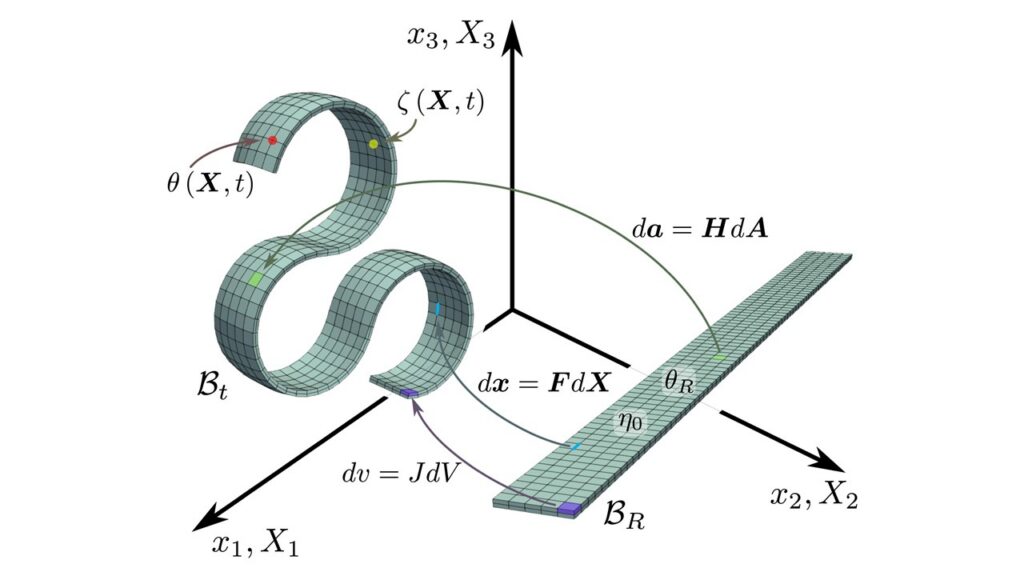
Constitutive models can satisfy the First and Second Laws of thermodynamics while remaining incompatible with the Third. This is the central finding of a study by researchers from the International Centre for Numerical Methods in Engineering (CIMNE) and Swansea University, published in the Journal of the Mechanics and Physics of Solids.
Specifically, the research examines common assumptions about how specific heat affects the mathematical description of materials subject to extreme deformation and temperature changes, and proposes an alternative framework for simulating such cases.
The paper, Finite strain thermoelasticity and the Third Law of thermodynamics, is authored by Prof. Javier Bonet, CIMNE’s General Director and researcher, and Dr Antonio J. Gil, Professor at the Zienkiewicz Institute for Modelling, Data and AI of the Faculty of Science and Engineering at Swansea University in Wales.
Constitutive models describe how materials respond to external conditions, relating quantities such as stress, deformation, and temperature. They are fundamental to computational solid mechanics, particularly when simulating complex thermomechanical behaviour.
In finite-strain thermoelasticity, it is typically assumed that specific heat coefficient, which describes how a material’s energy changes with temperature at a fixed state, is constant or depends only on temperature.
In their paper, Bonet and Gil demonstrate mathematically that these assumptions impose important restrictions when the Third Law of thermodynamics is considered, limiting accuracy.
The Third Law of thermodynamics establishes that, for systems with a non-degenerate ground state, entropy must approach zero as temperature approaches absolute zero (0 K). Authors show that models assuming constant positive specific heat instead predict an entropy that tends towards negative infinity at this limit.
“The Third Law places constraints on thermomechanical coupling that conventional constitutive models do not always account for,” explains Bonet, who is also a member of CIMNE’s Structural and Particle Mechanics research cluster.
An alternative framework for thermoelasticity
Building on these findings, the researchers propose an analytical constitutive framework in which specific heat is expressed through a multiplicative combination of two functions: one dependent on temperature and the other on deformation.
The resulting formulation satisfies the Third Law while maintaining consistency with the First and Second Laws. It also incorporates polyconvexity, a mathematical condition that supports the stability of the material model and ensures the existence of real wave-propagation speeds.
Potential Applications in Material Simulation
In the paper, the authors discuss several material behaviours for which these considerations may be relevant, like rubber-like materials, where elastic behaviour can be strongly influenced by entropy and deformation. This may have direct implications in key industries like automotive, construction, and healthcare.
The researchers also develop formulations capable of representing thermal softening and melting, including nonlinear changes in material response as temperature increases. Such behaviours are particularly relevant to computational problems involving multiple materials, extreme deformations and high temperatures, central in sectors such as aerospace engineering, nuclear energy, and additive manufacturing.
According to Bonet, “a more complete thermodynamic description could help improve the physical consistency of models used to investigate complex processes in advanced manufacturing or even healthcare”.
Authors, however, caution their research is still theoretical. “It establishes mathematical properties that should be validated experimentally for greater accuracy”, says Prof. Bonet.
Although the findings remain purely mathematical, conclusions from Bonet and Gil provide a foundation for future research on material simulation and behaviour predictability, with potential effects on advanced computing, industrial processes or the clean energy sector.