
Software
CIMNE develops high‑performance scientific and engineering software designed to address real‑world challenges across research, industry, and innovation. Our digital tools—built on decades of expertise in numerical methods and advanced computing—are used by universities, research centres, and companies worldwide.
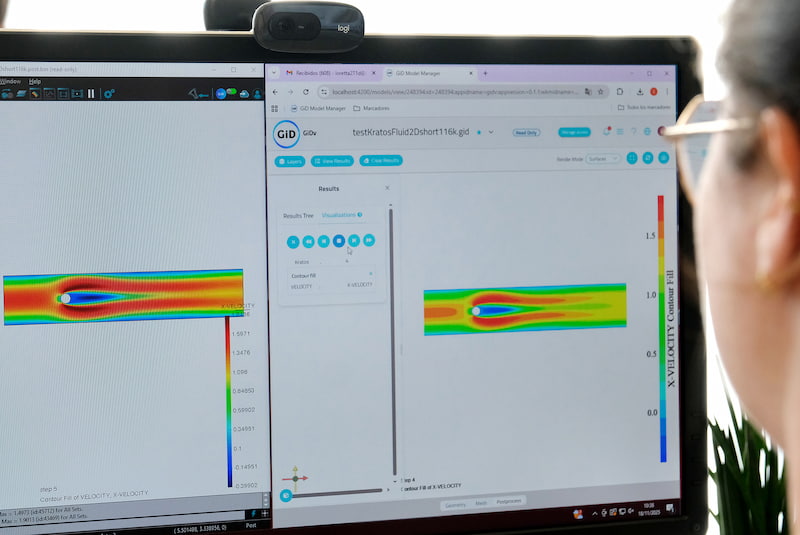

GiD
GiD is a universal, adaptive and user-friendly pre and post processor for numerical simulations in science and engineering. It has been designed to cover all the common needs in the numerical simulations field from pre to post-processing.


ADD2MAN
ADD2MAN is a high-performance computational platform developed by CIMNE and ArcerlorMittal, and commercialized by 61HEX, for large-scale industrial simulations. It features scalable parallel adaptive algorithms, automatic mesh refinement, and G-code-driven analysis, enabling precise, efficient modelling of advanced manufacturing processes.
Anura 3D
The Anura 3D software uses a dynamic explicit MPM formulation based on a multiple set of material points. Anura3D is capable of simulating multi-phase materials (dry, saturated, unsaturated soil) and free surface water.
References
-
- Fern, J., Rohe, A., Soga, K., & Alonso, E. (Eds.). (2019). The Material Point Method for Geotechnical Engineering: A Practical Guide (1st ed.). CRC Press. DOI: 10.1201/9780429028090
- Yerro, A., Alonso, E.E., Pinyol, N.M., 2015. The material point method for unsaturated soils. Géotechnique, 65(3): 201–217, ISSN 0016‑8505, DOI: 10.1680/geot.14.P.163

CALTEP
Caltep is a calculus program to solve the Poisson equation (Conduction heat problems) of 2D models.
References
-
- Zárate, F., Oñate, E. CALTEP: programa para el cálculo transitorio de la ecuación de Poisson. Centro Internacional de Métodos Numéricos en Ingeniería (CIMNE).

CODE_BRIGHT
CODE_BRIGHT is a Finite Element Method (FEM) program capable of performing coupled thermo-hydro-mechanical-chemical (THMC) analysis in geological media. It has been developed at both the Department of Civil and Environmental Engineering of the Polytechnic University of Catalonia (UPC) and the International Center for Numerical Methods in Engineering (CIMNE).
References
-
- Olivella, S., Gens, A., Carrera, J., Alonso, E.E., 1996. Numerical formulation for a simulator (CODE_BRIGHT) for the coupled analysis of saline media. Engineering computations.
EMANT
Emant is a set of calculation tools to solve electro-magnetic problems using the Finite Element Method. The current version can solve 2D magneto-static problems.
References
-
- Otin, R., Mora, J., Oñate, E., 2005. EMANT: integration of GiD and Kratos, open and flexible computational tools. IEEE/ACES International Conference on Wireless Communications and Applied Computational Electromagnetics 883–886, DOI: 10.1109/WCACEM.2005.1469725
- Mora, J., Otín, R., Dadvand, P., Escolano, E., Pasenau, M.A., Oñate, E., 2006. Open tools for electromagnetic simulation programs. COMPEL, 25(3): 551–564, DOI: 10.1108/03321640610666709

ERMES
ERMES is an open-source tool that solves Maxwell’s equations in the frequency domain using the Finite Element Method (FEM). It computes electromagnetic fields from static to high-frequency applications in complex 3D geometries and simulates wave propagation in complex materials such as plasma. Documentation and updates are available on GitHub.
References
-
- Otin, R., 2013. ERMES: A nodal-based finite element code for electromagnetic simulations in frequency domain. Computer Physics Communications 184(11): 2588–2595, DOI: j.cpc.2013.06.010
- Otin, R, 2025. ERMES 20.0: Open-source finite element tool for computational electromagnetics in the frequency domain. Computer Physics Communications 310, 109521, 2025. DOI: 10.1016/j.cpc.2025.109521

FEMUSS
FEMUSS is an advanced computational platform that uses sub-grid scale stabilized finite element methods to deliver high-fidelity, multiscale simulations for complex engineering problems. It allows for precise analysis and optimization across fluid flow, heat transfer, and structural mechanics.

IBER
Iber is a two-dimensional numerical model for the simulation of free surface flow in rivers and estuaries. Iber solves the full depth-averaged shallow water equations to compute the water depth and the two horizontal components of the depth-averaged velocity.
References
-
- Bladé, E., Cea, L., Corestein, G., Escolano, E., Puertas, J., Vázquez-Cendón, E., Dolz, J., Coll, A., 2014. Iber: herramienta de simulación numérica del flujo en ríos. Revista Internacional de Métodos Numéricos para Cálculo y Diseño en Ingeniería, 30(1): 1-10, ISSN 0213-1315, DOI: 10.1016/j.rimni.2012.07.004
-
- Sanz-Ramos, M., Sañudo-Costoya, E., López-Gómez, D., García-Feal, O., Bladé, E., Cea, L., 2025. Evolución de la modelización numérica bidimensional del flujo en lámina libre a través del software Iber. Revista Ingeniería del Agua, 29(2): 114-131, DOI: 10.4995/ia.2025.23259

KRATOS Multiphysics
KRATOS Multiphysics (“Kratos”) is a framework for building parallel, multi-disciplinary simulation software, aiming at modularity, extensibility, and high performance. Kratos is written in C++, and counts with an extensive Python interface.
References
-
- Dadvand, P., Rossi, R. & Oñate, E. An Object-oriented Environment for Developing Finite Element Codes for Multi-disciplinary Applications. Arch Computat Methods Eng 17: 253–297 (2010). DOI: 10.1007/s11831-010-9045-2
- Dadvand, P., Rossi, R., Gil, M., Martorell, X., Cotela, J., Juanpere, E., Idelsohn, S., Oñate, E, 2013. Migration of a generic multi-physics framework to HPC environments. Computers & Fluids. 80: 301–309. DOI: 10.1016/j.compfluid.2012.02.004
- Vicente Mataix Ferrándiz, Philipp Bucher, Rubén Zorrilla, Suneth Warnakulasuriya, Riccardo Rossi, Alejandro Cornejo, jcotela, Carlos Roig, Josep Maria, tteschemacher, Miguel Masó, Guillermo Casas, Marc Núñez, Pooyan Dadvand, Salva Latorre, Ignasi de Pouplana, Joaquín Irazábal González, AFranci, Ferran Arrufat, riccardotosi, Aditya Ghantasala, Klaus Bernd Sautter, Peter Wilson, dbaumgaertner, Bodhinanda Chandra, Armin Geiser, Inigo Lopez, lluís, jgonzalezusua, Javi Gárate. 2024. KratosMultiphysics/Kratos: Release 10.1 (v10.1). Zenodo. DOI: 10.5281/zenodo.3234644

OSI4IOT
OSI4IOT is an open-source software platform developed at CIMNE for creating live, sensor-driven Digital Twins. It brings together Internet of Things (IoT) data, asset information, geospatial data and computational models in a unified environment, connecting physical assets with their digital counterparts for monitoring, analysis and visualisation.
References
-
- Di Capua, D.; Pacheco-Blazquez, R.; García-Espinosa, J.; Pastor, A. OSI4IOT: An Advanced Open-Source Platform for Sensor-Driven IoT and Digital Twins Deployment. IoT 2026, 7, 61. DOI: 10.3390/iot7030061
PLCd
PLCd (PLastic Crack dynamic) is a finite element code designed for the numerical simulation of nonlinear dynamic behaviour in complex structural systems.
SLRA
SLRA is a C‑based package with MATLAB, Octave, and R interfaces for solving weighted structured low‑rank approximation problems. It supports mosaic Hankel structures, missing or fixed data, and linear constraints. The tool is mainly used for identifying linear time‑invariant systems.
References
-
- Markovsky, I., Usevich, K., 2014. Software for weighted structured low-rank approximation. Journal of Computational and Applied Mathematics 256: 278–292, DOI: 10.1016/j.cam.2013.07.048

STAMPACK
Stampack is the metal forming simulation software for many industrial applications such as ironing, necking, embossing, stretch-forming, forming of thick sheets, flex-forming, hydro-forming of multi chamber profiles, stretch-bending of profiles, etc.
References
-
- Rojek, J., Oñate, E., Postek, E., 1998. Application of explicit FE codes to simulation of sheet and bulk metal forming processes. Journal of Materials Processing Technology 80–81: 620–627, DOI: 10.1016/S0924-0136(98)00169-1

The Behavioral Toolbox
The Behavioral Toolbox is a collection of Matlab functions for analysis and design of dynamical systems using the behavioral approach to systems theory and control. It implements newly emerged nonparameteric data-driven methods for linear time-invariant systems.
References
-
- Markovsky, I., 2024. The Behavioral Toolbox. Proceedings of Machine Learning Research 242: 130–141. Link
WeldPilot
WeldPilot is a high-performance simulation tool developed at CIMNE and comercialised by COMPASS for the analysis and optimization of Friction Stir Welding (FSW) processes in industrial environments. Designed for integration with HPC systems, it enables accurate and efficient modelling of both thermal and mechanical aspects of the process, significantly reducing simulation time while ensuring predictive reliability.