A group of four CIMNE researchers, led by Dr. Michele Chiumenti as senior author, have developed a new Mechanism-Based (MB) orthotropic damage criterion for Fused Filament Fabrication (FFF), a popular and affordable 3D printing technology of Additive Manufacturing that produces complex layered components.
In a paper entitled Mechanism-Based damage and failure of Fused Filament Fabrication components the researchers from CIMNE’s Industrial Manufacturing Processes RTD group used a Mechanism-Based (MB) damage material model to study the failure mechanics of FFF and developed a novel MB damage criterion considering damage driven by different failure modes.
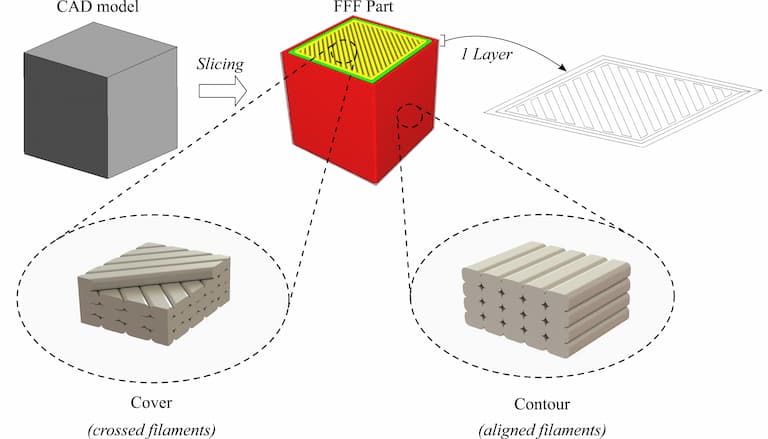
3D printing scheme and printing patterns present in a FFF component.
In the manuscript, authors Iván Rivet and collegues, propose an MB cracking model that incorporates the orthotropic brittleness of FFF components and use experimental and numerical simulations to compare their criterion to that of Tsai–Wu (TW), which is commonly used for orthotropic materials.
According to the researchers, the results of the novel MB damage criterion outperform those of TW, and can accurately match experimental outcomes and predict the breaking mechanism even in complex 3D states.
In Iván Rivet’s words, this new model allows for “reduced-cost high-fidelity simulations of Additive Manufacturing components”, and will enable “a better understanding of their orthotropic mechanical properties and mixed failure modes”.
All the research has been developed in the International Centre for Numerical Methods in Engineering (CIMNE) by Iván Rivet (Conceptualization, Software, Writing, and Editing), Narges Dialami (Methodology, Validation, and Review), Miguel Cervera (Conceptualization, Supervision, and Review), and Michele Chiumenti (Conceptualization and Software).
The manuscript, which is already available online for a fee, will be published in the volume 270 of the Composites Part B: Engineering journal in February 2024.