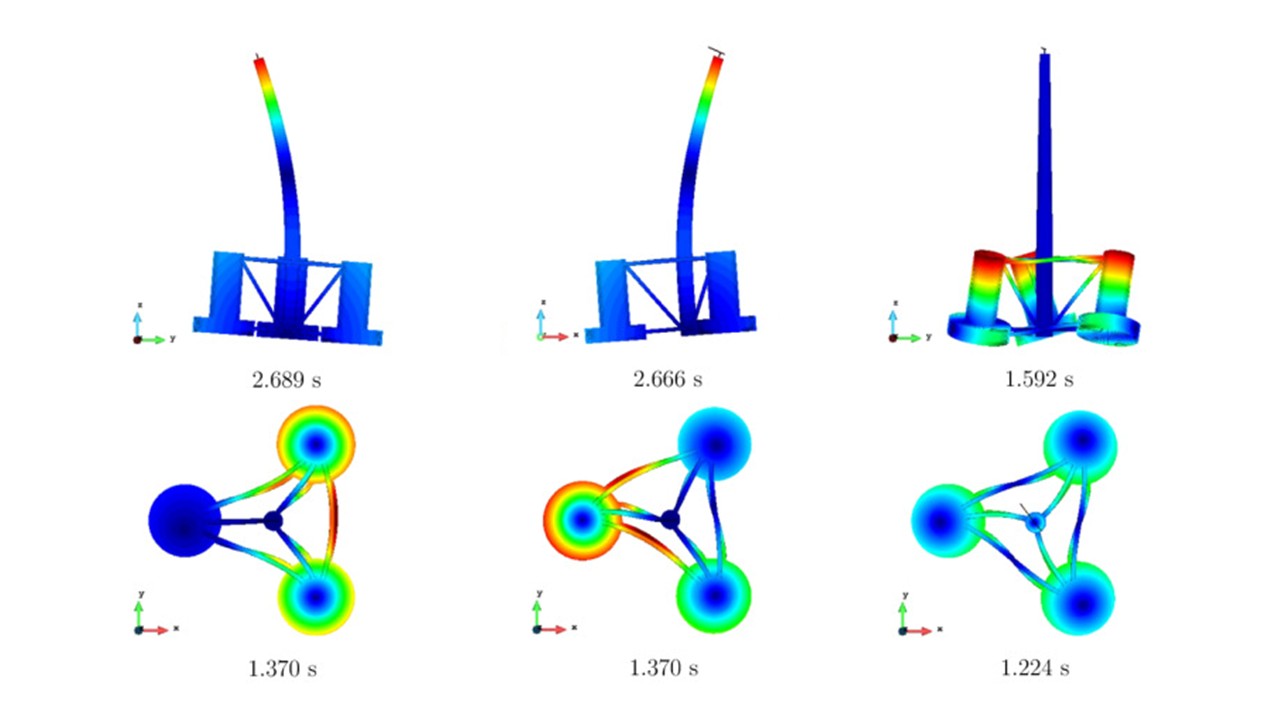
First elastic dry modes and modal periods. Colorfill represents the structural displacements. [1]
The recognition represents an important step towards the industrial adoption of a computational methodology that accelerates the analysis of ships, floating wind platforms and other offshore structures while maintaining a high level of accuracy.
The EMMR methodology has been implemented in SeaFEM, a computational simulation software for analysing naval and offshore structures. SeaFEM combines a high-fidelity finite element-based hydrodynamic solver with a generalised mode-based structural reduced-order model, enabling highly efficient simulations while preserving accuracy comparable to that of full-order structural finite element models.
The science behind EMMR
The achievement builds on several years of research, development and validation. The scientific foundations of EMMR and its applications to floating wind structures, ships and semi-submersible platforms are presented in three recent peer-reviewed publications.
Floating wind structures
This first study introduces the reduced-order methodology and applies it to fully coupled aero-hydro-servo-elastic simulations of floating wind substructures, accounting for the interaction between aerodynamic loads, waves, structural behaviour and turbine control systems. The results show substantial computational savings while preserving engineering accuracy and capturing relevant resonance effects that play a critical role in the response of floating offshore structures.
Hydroelastic ship analysis
This work presents an efficient framework for hydroelastic ship analysis that reduces the size of the structural problem by approximately 98% while maintaining accuracy comparable to full-order models. The methodology also supports the development of physics-based structural digital twins combining monitoring data and predictive simulation.
Structural stresses in a semi-submersible platform
During Phase II of the OC7 project, SeaFEM was used to assess structural stresses in the VolturnUS-S reference platform through fully coupled hydroelastic time-domain analyses. Among the approaches evaluated, SeaFEM was the only solution based on a fully integrated time-domain load and structural analysis workflow with strong global-to-local coupling.
The path to industrial impact
The Approval in Principle follows an independent review by Lloyd’s Register of the methodology and its underlying technical principles. Lloyd’s Register is a global professional services organisation specialising in engineering, technology and assurance for the maritime and offshore industries.
The development of EMMR involved CIMNE’s Marine and Offshore Engineering research group, led by Dr Borja Serván; CompassIS, a CIMNE spin-off specialising in solutions for civil, naval and maritime engineering; and researchers from ETSI Navales.
By reducing computational time, EMMR enables fully coupled, time-domain hydroelastic simulations for engineering design and certification workflows. This can support more efficient design processes, improve the assessment of structural performance and facilitate the use of high-fidelity simulation in applications where conventional full-order models would be too computationally demanding.
In 2025, CIMNE managed 115 research and technology-transfer contracts with companies while 16% of the centre’s publications were co-authored with industrial partners. These collaborations form part of CIMNE’s commitment to transferring scientific knowledge and advanced computational technologies to industry, with the aim of generating technological and societal impact.
References
[1] Servan-Camas, B., Berdugo-Parada, I., Garcia-Espinosa, J., Pastor-Sanchez, A. (2025). Modal matrix reduction for fully coupled integrated load analysis of floating structures. Marine Structures 103, 103845. https://doi.org/10.1016/j.marstruc.2025.103845
[2] García‑Espinosa, J., Lorente‑López, A.J., Serván‑Camas, B., Gutierrez‑Romero, J.E. (2026). Accelerated fully coupled hydro‑elastic analysis of ships using a combined full and modal‑reduced FEM approach. Marine Structures 108, 104011. https://doi.org/10.1016/j.marstruc.2026.104011
[3] Karch, M., et al., 2026. OC7 project Phase II: comparison of global‑to‑local load transfer approaches in floating structures. Wind Energy Science 11, 2427–2446. https://doi.org/10.5194/wes‑11‑2427‑2026