Recently, researchers from CIMNE, CIMNE Tecnología and the spin-off of the Fresh Water Nature (FWN) research centre collaborated in the publication of an article titled “Cool Steam Method for Desalinating Seawater” in Water, a peer-reviewed, open access journal on water science and technology.
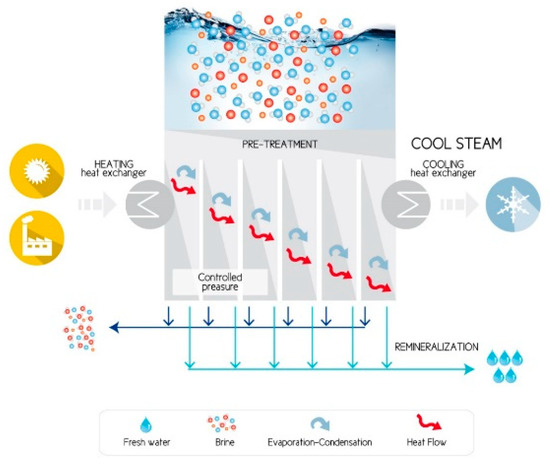
Cool steam is an innovative distillation technology based on low-temperature thermal distillation (LTTD), which allows obtaining fresh water from non-safe water sources with substantially low energy consumption. LTTD consists of distilling at low temperatures by lowering the working pressure and making the most of low-grade heat sources (either natural or artificial) to evaporate water and then condensate it at a cooler heat sink.
To perform the process, it is necessary to have an external heat source that provides the latent heat of evaporation and a temperature gradient to maintain the distillation cycle. Depending on the available temperature gradient, several stages can be implemented, leading to a multi-stage device. The cool steam device can thus be single or multi-stage. Raw water is fed from the top in every stage and it evaporates in contact with the warmer surface within the said stage. Acting as a heat carrier, the water vapor travels to the cooler surface and condensates when in contact with it. The latent heat of condensation is then conducted through the conductive wall to the next stage. Net heat flux is then established from the heat source until the heat sink, allowing distilling water inside every parallel stage.