
Researchers from the Machine Learning in Civil Engineering group at CIMNE have developed a new machine-learning based software to predict structural behaviour of dams, allowing for enhanced decision-making and minimizing safety risks of these critical infrastructures.
The tool, called SOLDIER: SOLution for Dam Behavior Interpretation and Safety Evaluation, uses machine learning models instead of legacy simple linear regression solutions, allowing for greater flexibility, versatility, and precision, making it easier for engineers to detect anomalies.
Doctors Fernando Salazar, Joaquín Irazábal, and André Conde have published a scientific paper detailing the research behind the SOLDIER software and its capabilities, and how it allows for interactive data exploration, model fitting, and interpretation.
The user-friendly application, which can be downloaded for free, follows multi-year research efforts, and it has been tested in different real-world settings. The software has garnered international recognition and won the highly competitive Verbund’s Innovation Challenge in 2017, awarded by the Austrian hydropower company Verbund.
According to its authors, SOLDIER can be used in the structural health monitoring of civil structures other than dams. Various CIMNE research groups have already utilized SOLDIER to perform model accuracy tests.
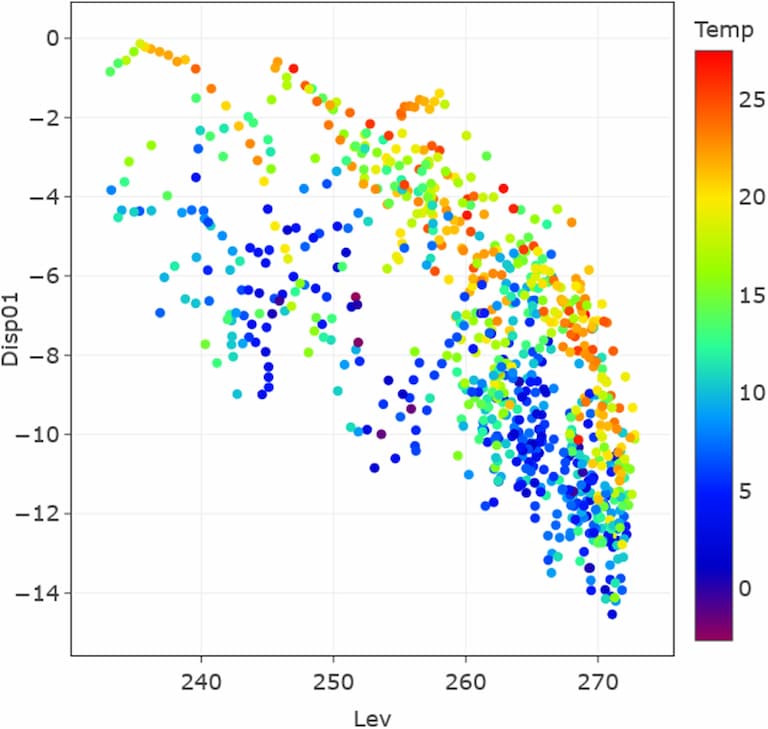
Scatterplot showing a response variable (displacement) as a function of the reservoir level (horizontal axis) and the air temperature (colors).
This line of work began with Dr. Salazar's PhD thesis in 2017 and continued under the framework of various local and international projects.
According to Dr. Salazar, dams are “critical structures” that provide “vital services”, but pose “potential risks” in case of failure “which, fortunately, are highly infrequent”. In Prof. Salazar’s words, “it is essential” to monitor water dams, “not only to avoid accidents, but also to optimise maintenance tasks by detecting anomalies at an early stage”.
The Spanish State Investigation Agency (Agencia Estatal de Investigación), European Commission’s Regional Development Fund and NextGeneration programme, and Catalan Government’s CERCA programme provided funds for this work.