



Researchers from the Bio-medical Engineering Research Group at the International Centre for Numerical Methods in Engineering (CIMNE) have proposed a special type of Finite Element (FE) technology in a new paper entitled Empirical Interscale Finite Element Method (EIFEM) for modeling heterogeneous structures via localized hyperreduction.
The article introduces the novel Empirical Interscale Finite Element method (EIFEM) for modelling diverse structures under both dynamic and static analysis. Unlike traditional multiscale methods, this approach avoids nested local/global issues in the nonlinear regime by directly linking coarse-scale nodal internal forces with fine-scale stresses through an “interscale” variational formulation.
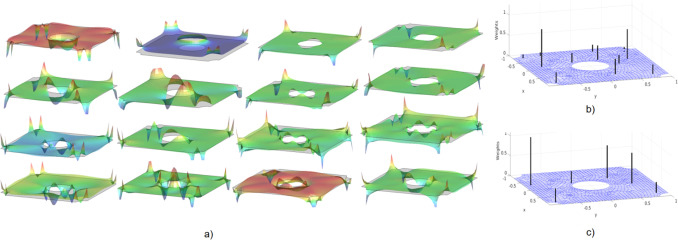
In the manuscript, the authors J. A. Hernández (CIMNE, UPC), A. Giuliodori (CIMNE, UPC) and E. Soudah (CIMNE) point out that this novel method, by adjusting the number and location of the integration points, the corresponding weights, and the definition of the strain-displacement matrices, preserves the original constitutive laws of heterogeneous materials without the need for complex nested solvers or analytical approximations.
Prof. Eduardo Soudah, head of CIMNE’s biomedical research group, points out that this research “enables a further advancement” in the numerical methods employed to analyse the mechanical behaviour of medical devices. According to Prof. Soudah, this work “addresses the emerging challenges posed by the development of new materials and complex geometries in the field of medical devices”.
In Professor Soudah’s words, this special type of Finite Element (FE) technology will “facilitate the evaluation and optimization of design alternatives customized for individual patients in the medical device industry”, while “markedly reducing computational time and costs” compared to the standard FE method.
The work will be published in the January 2024 issue of Computer Methods in Applied Mechanics and Engineering journal, and it is already available online.