
See how advanced simulation enhances nuclear safety

Learn how the UNESCO Chair in Numerical Methods spearheads frontier innovation in the Global South

News

Back

CIMNE experts use Machine Learning to streamline reservoir risk assessment

Mar 8, 2024

Researchers at CIMNE's Machine Learning in Civil Engineering Research Group and the Flumen Institute have developed a new machine-learning based tool to classify off-stream reservoirs based on their potential risk of rupture.

The work, carried out as part of the ACROPOLIS project, used high performance computing to simplify and automate the process of pre-classifying reservoirs, allowing authorities and owners of the nearly 70,000 reservoirs in Spain streamlined access to valuable safety data.

Experts, led by Dr. Fernando Salazar and Dr. Ernest Bladé, enhanced the capabilities of the Iber numerical modelling tool, also developed at CIMNE by feeding its results into a machine learning model, achieving a confidence level over 80% in risk assessment and pre-classification.

Researchers used ad hoc methodologies to automatically extract hydraulic and hazard information at vulnerable points, allowing for numerical models of greater detail and resolution.

The ACROPOLIS project also enabled “affordable computation times” for 2D hydraulic modelling, over 85 times faster than previous versions, paving the way for a streamlined assessment of these vital civil infrastructures.
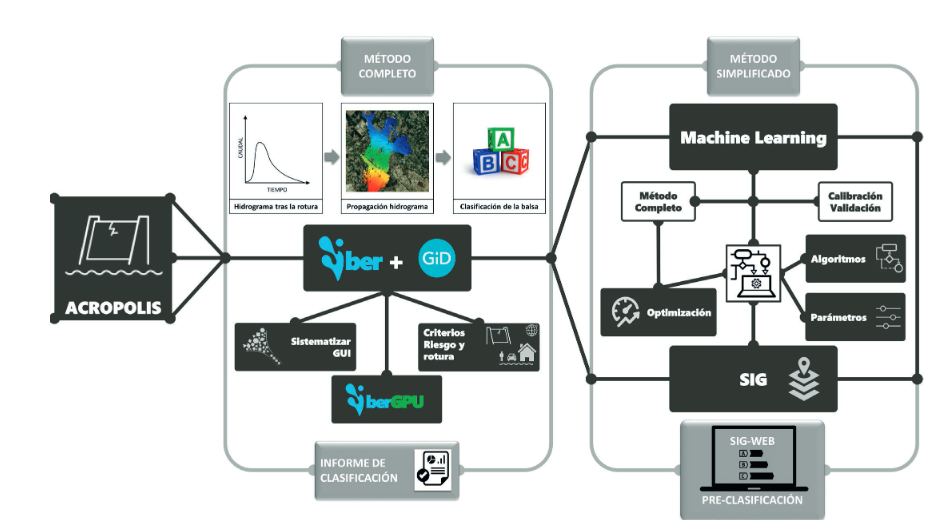
Conceptual outline for the development of the ACROPOLIS project.

Conceptual outline for the development of the ACROPOLIS project.

As part of the project, the researchers further improved the usability of the Iber modelling software, updating its graphical interface and adding new functionalities such as automatic report generation, facilitating process automation.

Since 2008 Spanish legislation requires owners of off-streams reservoirs of over 5 meters or 100,000 cubic meters to assess the potential risk of failure. The law responds to European directives to mitigate negative consequences of floods through Flood Risk Management Plans (FRMPs).
Related News

CIMNE Launches DAMSHAI Project to Advance Dam Safety Through Artificial Intelligence

The International Centre for Numerical Methods in Engineering (CIMNE) has launched DAMSHAI (Dam Structural Health Monitoring and Safety Assessment with an AI Agent), a three-year research project that will explore the application of artificial intelligence to critical...

Retaining walls, landslides and geotechnical safety: Dr Pinyol explains the risks and tools to prevent them.

The persistent rainfall that fell in Catalonia in January 202 led to tragic situations, such as the Gelida rail accident caused by the collapse of a retaining wall, as well as landslides in other parts of the commuter network. We speak with Dr Núria M. Pinyol, a...

Complex orography, ageing infrastructure and lack of capacity: CIMNE experts warn of the fragility of commuter rail network in Catalonia

On Tuesday, 27 January 2026, in Gelida, Catalonia, a commuter train collided with a retaining wall that is believed to have come loose due to heavy rain. The accident resulted in one fatality, a trainee driver, and 37 people were injured. As a result of the incident,...

Tags