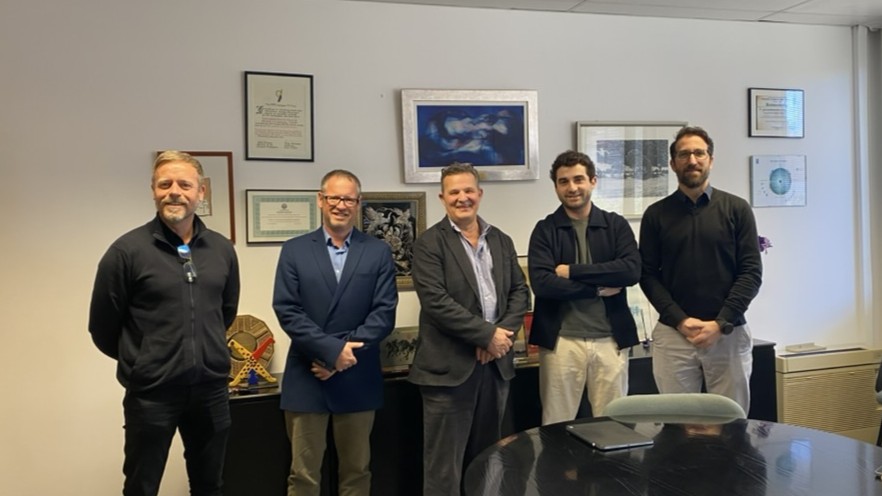
The International Centre for Numerical Methods in Engineering (CIMNE) and AddiCraft Engineering have signed an agreement to strengthen collaboration in the field of advanced engineering, with a particular focus on innovation, applied research, and technology transfer.
The document, signed on Wednesday, 15 April, reflects the shared commitment of both organisations to fostering closer links between scientific knowledge and industrial application, creating new opportunities for collaboration in areas such as structural optimisation and advanced simulation.
CAMMS’s expertise in topology optimisation
The agreement builds on the research and innovation activities carried out at CIMNE, particularly through the Composites and Advanced Materials for Multifunctional Structures (CAMMS) group, from the CIMNE’s research cluster in Aeronautical, Marine, Automotive and Energy Engineering. Researchers at CAMMS develop advanced numerical methods and procedures for the prediction and characterisation of the performance of composites and multifunctional materials, applied to large-scale structures in sectors such as aerospace, aeronautics, marine, automotive, and energy.
Their research addresses one of today’s major transport challenges through the development of advanced lightweight structures that help reduce fuel consumption and environmental impact. Through topology optimisation and advanced simulation, CAMMS contributes to improving structural efficiency, reducing material usage, and enabling designs that are better suited to advanced manufacturing processes, including additive manufacturing.
Shared vision for innovation and impact
Through this collaboration, AddiCraft Engineering will benefit from CIMNE’s scientific and technological expertise. At the same time, CIMNE will strengthen the industrial projection and practical application of its research activities through a closer connection with market needs and engineering practice.
The agreement represents a step forward in the shared will of both organisations to promote innovation with industrial impact, facilitating the transfer of advanced knowledge to real engineering challenges. It also opens the door to exploring future joint initiatives in research and development, talent generation, and high-value engineering projects.