
ABSTRACT
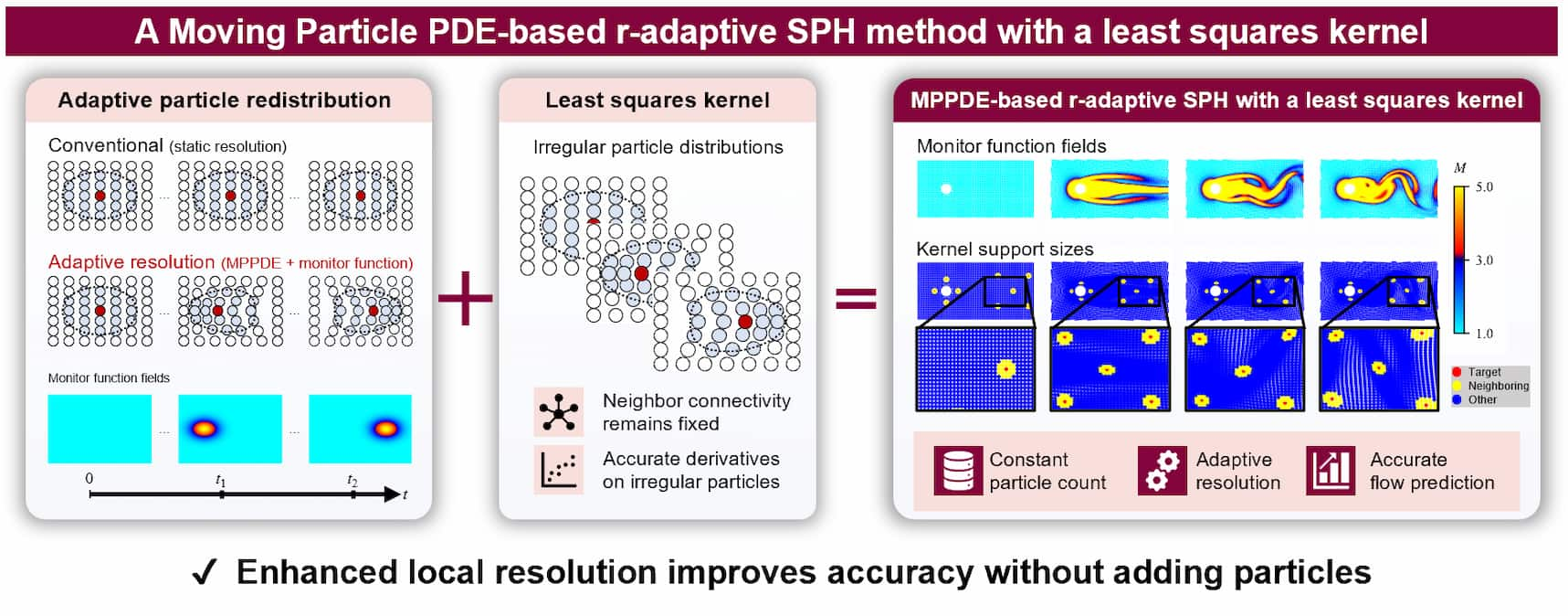
Recent advancements in particle methods address the limitations where conventional smoothed particle hydrodynamics (SPH) requires ideal, uniform spatial particle distributions to guarantee convergence. Building upon these developments, we present a Moving Particle PDE (MPPDE)-based r-adaptive SPH framework designed for incompressible flow simulations.
In this approach, particle velocities are determined by an MPPDE using a monitor function rather than being constrained strictly to fluid velocities, enabling dynamic spatial resolution redistribution while maintaining a constant total number of particles. To overcome accuracy degradation on irregular particle distributions, a fixed-stencil least-squares SPH (LS-SPH) formulation is implemented, keeping neighboring connectivity fixed in computational space while reconstructing spatial derivatives directly from current physical coordinates. Additionally, a reference-configuration-based correction is introduced into the MPPDE formulation to successfully eliminate artificial particle motion caused by initial configurations. Comprehensive numerical evaluations—including the Taylor-Green vortex, lid-driven cavity flow, backward-facing step flow, and flow past a circular cylinder—demonstrate that the proposed method achieves high-fidelity solutions and robust computational efficiency compared to conventional SPH techniques.
SPEAKER
 Shujiro Fujioka is a Ph.D. candidate in the Department of Civil Engineering at the Graduate School of Engineering, Kyushu University, conducting his research in the Disaster Informatics Laboratory under the supervision of Professor Mitsuteru Asai. He received his bachelor’s and his master’s degrees in Civil Engineering in 2022 and 2024, both from Kyushu University. His research focuses on particle methods for fluid analysis, with the goal of contributing to disaster prevention and mitigation.