
ABSTRACT
Deep Geological Disposal (DGD) has emerged as the most viable solution for the final disposal of radioactive waste, offering the potential for the permanent containment and isolation of waste from the biosphere over extended timescales. Several countries have made significant progress in developing Deep Geological Repository (DGR) concepts for the permanent disposal of such waste. The long-term safety of these facilities relies primarily on the host rock—the natural barrier that plays the central role—supplemented by engineered components collectively referred to as the engineered barrier system (EBS). The EBS includes containers, backfills, buffers, and other structures designed to ensure favourable conditions for the long-term isolation of radioactive waste. The design, performance, and safety assessment of a DGR—and particularly of its EBS components—are therefore essential for the sustainable development of nuclear energy, making their study a key research area within geotechnical engineering.
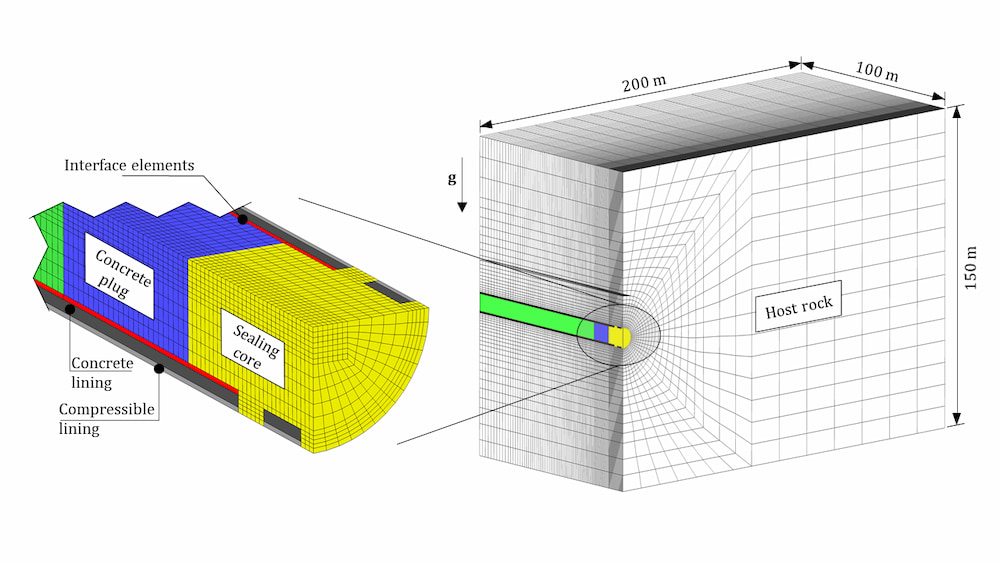
In this context, the main objective of this research is to contribute to the understanding and assessment of the long-term performance of a large-diameter sealing concept developed within the framework of the Cigéo project, led by the French National Radioactive Waste Management Agency (Andra). To achieve this objective, a multi-scale and multi-step numerical modelling strategy has been adopted. The approach combines detailed material characterisation with advanced constitutive modelling of the expansive core, backfill materials, and host rock, accounting for features such as inherent anisotropy and double structure. The modelling framework incorporates coupled hydro-mechanical processes, enabling the analysis of key phenomena such as the natural hydration of the sealing core, the development of swelling pressure, the resaturation and recompression of the excavation-damaged zone (EDZ), the global equilibrium of the sealing system, and the potential deconfinement of the sealing core and its associated loss of swelling capacity. The simulations address the complexity of the problem by integrating large-scale three-dimensional geometries, advanced constitutive formulations, and critical geometric details at the decimetre scale. These challenging simulations provide valuable insights into the performance and long-term integrity of the sealing structures, establishing a robust framework and a powerful tool to enhance the understanding of the behaviour of these EBS, contributing to the optimisation of repository design and safety.
Committee
- President: Prof. Jean Sulem
- Secretary: Prof. Antonio Gens
- Member: Dr. Jean Talandier
PhD Advisors:
- Prof. Jean Vaunat
- Prof. Sebastià Olivella Pastallé
PHD CANDIDATE
 Matías Alonso is a PhD candidate at CIMNE’s Geomechanics group, part of the Geomechanics and Hydrogeology research cluster. His research specializes in hydro-mechanical modelling of sealing concepts and engineered barrier systems for deep geological radioactive waste repositories.