



Professor Karen Willcox, director of the Oden Institute for Computational Engineering and Sciences, and member of the Scientific Advisory Council at CIMNE, believes digital twin technology has the potential to “revolutionise decision-making” across “science, technology, and society”, with a particular relevance in the field of medicine, where its applications are “tremendous”.
Dr. Willcox shared her views on digital twins yesterday in a public seminar at Palau Robert in Barcelona, as part of the lecture series Engineering challenges that may change the world: Reflections in the 50th anniversary of Barcelona’s School of Civil Engineering, organized by the International Centre of Numerical Methods in Engineering (CIMNE), the Mathematical and Computational Modeling research group (LaCàN) and Barcelona School of Civil Engineering at the Technical University of Catalonia (UPC).
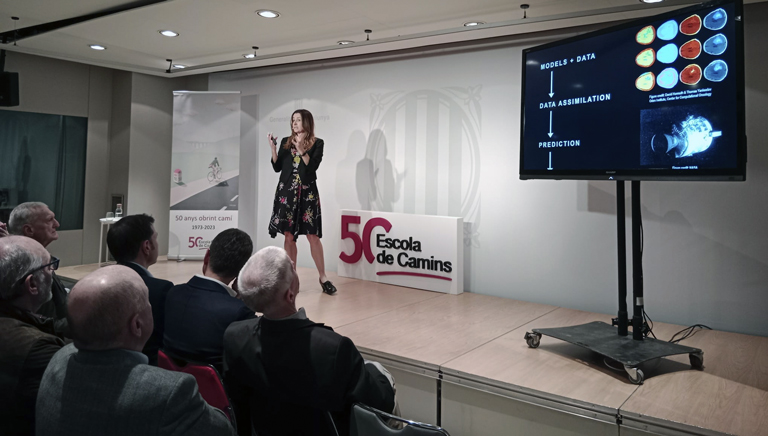
Prof. Willcox highlighted the revolutionary impact of digital twins during her talk
Prof. Willcox defined digital twin methodology, which generates a virtual model to reflect a physical object in real time, as a “scientific grand challenge” and referred to digital twins as the “the next-generation of mathematical modelling and computational science.”
At the conference, presented by CIMNE’s Scientific Director Pedro Díez, Dr. Willcox offered an overview on the history of digital twin technology, which was first applied in physical simulators at NASA to simulate outer space conditions to enhance decision-making. The speaker pointed out that advances in this technology can now improve healthcare in areas such as radiotherapy in oncological patients, helping doctors decide on the frequency of treatments.
Dr. Willcox introduced the audience to the basic technical concepts of digital twin technology, emphasising the importance of bidirectional feedback flows between the physical and virtual models in order to adapt and adjust the latter to achieve better predictions of behaviour. Prof. Willcox also listed the challenges of predictive modelling in achieving a digital model, namely working with complex physical phenomena, high dimensionality of parameter spaces, computational constraints, and limited data.
The speaker also reflected on the conceptualisation of digital twins, emphasising that, although this technology is commonly seen as related to big data, its core lies on a mathematical model, supported by a numerical model. In Prof. Willcox’s words, “big data alone is not enough”, and digital twins in engineering, science, and medicine “must incorporate the predictive power, interoperability, and domain knowledge of physical models”.
Speaking to a largely professional audience, including CIMNE Director Javier Bonet, Founding Director Eugenio Oñate, and members of CIMNE's Scientific Advisory Board, Dr. Willcox also emphasised the “importance of dissemination in science” and encouraged participants to explain to decision-makers and society “why it is important to continue investing in research in engineering and computational sciences”.
As a member of the International Centre of Numerical Methods in Engineering’s Scientific Advisory Council, Prof. Willcox participated in CIMNE’s annual advisory council meeting in Barcelona on November 20 and 21 to provide advice and guidance on the scientific policy at CIMNE.
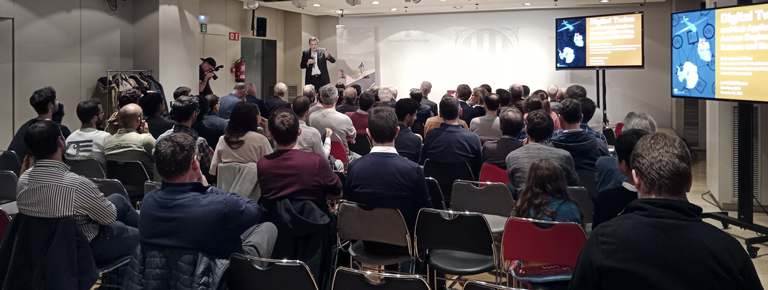
Dr. Willcox shared her views on digital twins at a public seminar at Palau Robert in Barcelona