


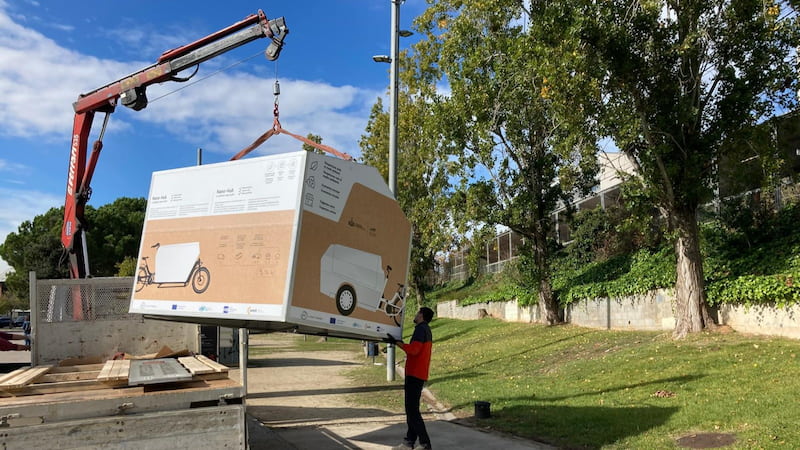
As of today, Sant Cugat will host modular goods transfer zones in Plaça Joan Borràs and on Rambla del Torrent d’en Xandri. They have also been installed in other Catalan cities including Granollers, Sabadell and Mataró. These “nanotransfer hubs”, a pioneer in Europe, allow loads to be transferred from trucks to electric bikes and other low-emission vehicles for the final urban delivery stage, reducing urban congestion and providing more sustainable last-mile delivery solutions.
Urban goods distribution traditionally relies on large vehicles circulating through city streets, contributing to congestion and CO₂ emissions. Nanohubs tackle the environmental and operational challenges of urban delivery by proposing an alternative through small modular transhipment zones.
These compact, flexible logistic hubs allow delivery vans to unload goods that are then distributed locally using cargo bikes or other low-emission vehicles. The objective is to reduce traffic, improve air quality and optimise last-mile logistics.
The innovative element of these facilities is their capacity to create shared transfer zones among multiple private actors. This multi-actor approach also makes the solution particularly attractive to public entities while encouraging the development of a network of sustainable urban logistics infrastructure.
The initiative is part of the NanoHubZone project, funded by EIT Urban Mobility, an initiative of the European Institute of Innovation and Technology (EIT), a body of the European Union. Its implementation in Sant Cugat has been developed in collaboration with AMTU, CIMNE and OVO Urban Logistics, with support from Som Ecologista, BikeLogic, and the Sant Cugat Town Council.
Sant Cugat’s Nanohubs will enable the evaluation of whether small-scale, shared logistics can contribute to more efficient delivery systems, with potential for scaling the solution to other European cities. In addition to the pilot in Catalonia, the NanoHubZone project is also being implemented in Brussels, managed by Bruxelles Mobilité and the Vrije Universiteit Brussel (VUB).
The inauguration event allowed logistics operators to observe the system in operation and provided municipal representatives the opportunity to assess its potential impact on local urban mobility and commercial activity. Through close collaboration with local councils and stakeholders, the project ensures alignment with public mobility goals, fosters new public-private partnerships to facilitate deployment and contributes to improved urban quality of life.
According to Paco Gasparín, principal investigator of the project at CIMNE’s Transport Innovation Unit (CENIT), “the initiative has significant growth potential, as it not only proposes a scalable solution for sustainable urban logistics but also lays the foundation for replicating it in other urban areas worldwide.”