



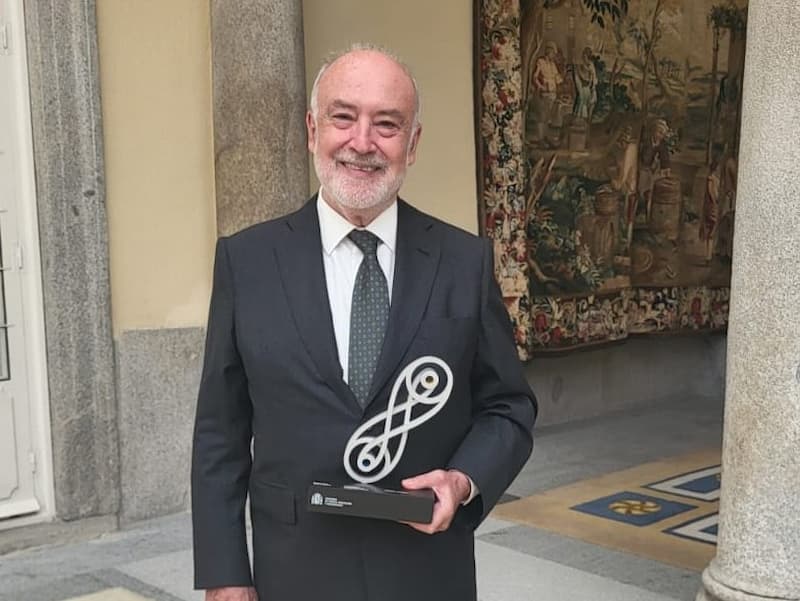
Professor Eugenio Oñate, founder of the International Centre for Numerical Methods in Engineering (CIMNE) and full professor at the UPC School of Civil Engineering, was elected on November 18 as a member of the Royal Academy of Engineering of Spain (Real Academia de Ingeniería), a prestigious institution that promotes excellence, quality, and competence in Spanish engineering across all its fields and areas of activity.
Professor Eugenio Oñate, born in València in 1953, is a civil engineer from the University of València and obtained his PhD in 1979 at the Department of Civil Engineering of the University of Swansea, in Wales (UK). Along his large career of more than 45 years as a professor and researcher at UPC School of Civil Engineering and CIMNE, Prof Oñate has extensively contributed to the development of numerical methods in the fields of structural mechanics, fluid dynamics and coupled engineering applications. With a long professional trajectory, he is a pioneer and an international reference in computational engineering.
Prof Oñate is the most cited Spanish civil engineer, with 467 papers published in JCR journals, more than 14,000 citations and an h-index of 69 according to Scopus. His prolific career has had a profound impact on the scientific community: he founded CIMNE in 1987 and was its director until 2022; he headed the UPC School of Civil Engineering from 1983 to 1989; he was the founder director of the Spanish Society for Numerical Methods in Engineering; he led the European Community on Computational Mechanics in Applies Sciences (2000-2004); and he chaired the International Association for Computational Mechanics (2002-2010). In 2024, he received the National Research Award (Torres Quevedo category) in Engineering and Architecture, granted by the Ministry of Science, Research and Universities of Spain.
Prof Oñate has combined his academic activity with a strong entrepreneurial vocation, which has led to the creation of several technological spin-off companies from CIMNE in Spain, five of which have successfully commercialised software and products derived from research. His work has driven high-quality research, innovation and technology transfer to transform knowledge into applications whit social impact. Under his direction, CIMNE has become an international benchmark centre for numerical methods in engineering.
Founded in 1994 by the Spanish Ministry of Science and Education, the Royal Academy of Engineering (Real Academia de Ingeniería, RAI) is an institution composed of 60 distinguished professionals from academic and business backgrounds across the disciplines encompassed by engineering and architecture. Since its inception, the RAI has worked in coordination with major worldwide academies to promote international relations in engineering. It is part of Euro-CASE, the group of leading European academies, and of CAETS, the world council of the most important engineering academies internationally.
The RAI has an extensive network involving universities, companies, industry, foundations, other royal academies, public administration, international organisations and the media. Its primary objectives are to promote engineering within society and to provide independent advice to public and private institutions on matters related to engineering. The academy also facilitates the exchange of knowledge, ideas and opinions between engineering and business in order to contribute to the progress and wellbeing of society.
The election of Professor Eugenio Oñate as a member of the Spanish Royal Academy of Engineering is a recognition of his commitment to excellence in research in the field of computational engineering and to the creation of solutions to social challenges. Professor Oñate will formalise his incorporation into the RAI with an inaugural address to the academy scheduled for the first half of 2026.