
ABSTRACT
This work explores the benefits and challenges of advanced Finite Element Methods for metal forming and manufacturing processes. As these processes become increasingly complex, FEM has emerged as a crucial tool. It helps predict physical quantities, aiding engineers in decision-making and enhancing the efficiency of development and production chains.
Metal forming often involves (nearly) isochoric behavior due to plastic deformations, which can cause the standard Finite Method to become unstable. To address the isochoric behavior and ensure local convergence of strains and stresses, this study utilizes mixed finite element formulations, including the displacement-pressure (u/p), displacement-strain (u/ε), and displacement-pressure-deviatoric strain (u/p/e) formulations. To mitigate the high computational cost of the u/ε and u/p/e formulations, the Adaptive Formulation Refinement (AFR) technique is developed. This technique selectively activates the enhanced formulations based on physical criteria or error estimation. The method’s accuracy and convergence rate is studied and compare favorably to reference solutions. The method is successfully applied to quasi-brittle structural failure analysis.
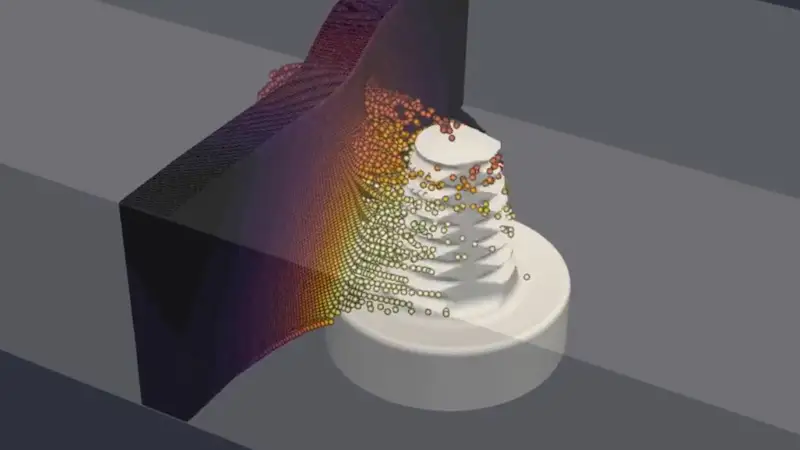
This work further addresses the practical application of advanced numerical methods to complex manufacturing problems, notably Friction Stir Welding (FSW), which is a solid-state welding technique. FSW is characterized by isochoric deformations, extremely high strain rates, and highly non-linear and temperature-dependent material behavior. An Embedded Finite Element Method is employed to simplify the modeling of complex geometries and moving boundary conditions. It uses a purely Eulerian framework and a discrete level-set function for tool modeling and works directly with CAD tool geometries. The simulation results align well with experimental data. A parameter study of process parameters is carried out to evaluate their impact on welding forces and temperature evolution, demonstrating the tool’s usefulness in aiding development processes.
To enhance usability, a Graphical User Interface (GUI) is developed for creating simulation input files and managing simulations. Additionally, a particle tracing algorithm is implemented to visualize material flow. This work aims to bridge the gap between academic research and practical engineering applications. It provides advanced, yet robust and efficient numerical tools for simulating metal forming and manufacturing processes.
Committee
- President: Dr Jean-Philippe Ponthot
- Secretary: Dr Javier Principe
- Member: Dr Benjamin Klusemann
PhD Advisors
PHD CANDIDATE
 Mr. Henning Venghaus is a PhD candidate at the Polytechnic University of Catalonia (UPC) and works as a researcher at the International Center for Numerical Methods in Engineering (CIMNE) in Barcelona, Spain. He studied mechanical engineering with a focus on structural mechanics and numerical methods at the Otto von Guericke University (OVGU) in Magdeburg and holds an MSc of Engineering. His research focuses on advanced Finite Element technologies, particularly mixed formulations, adaptive refinement strategies and embedded domain methods, and on facilitating technology transfer between academic institutions and industry partners. His doctoral thesis aims to apply newly developed numerical methods to industrial manufacturing processes, particularly Friction Stir Welding.