
ABSTRACT
Cemented sands are widely encountered in natural and engineered systems, ranging from biocemented soils to sandstones, where inter-particle bonding plays a critical role in mechanical behavior. Accurately modeling the influence of cementation on deformation and failure remains challenging due to the complex coupling between granular fabric and cementation characteristics at the particle scale. This thesis establishes a comprehensive numerical framework based on the Discrete Element Method (DEM) for modeling weakly and strongly cemented sands, integrating numerical developments, micromechanical modeling, and experimental validation.
Following a modeling philosophy of progressing from simple to complex, cemented sand is represented as a combination of a clean sand skeleton and superimposed cementation. This approach enables a clear separation between granular and bonding contributions, improves physical interpretability, and reduces excessive numerical calibration. The research comprises theoretical developments in DEM methodology and application studies covering non-cemented, weakly cemented, and strongly cemented granular materials, systematically validated against experimental data.
At the theoretical level, a standardized framework for particle packing generation is proposed, explicitly formalizing tacit knowledge embedded in empirical procedures. An Improved Radius Expansion with Servo control and Random shifting (IRESR) algorithm is introduced to ensure robust stress control and mitigate boundary effects, and the open-source tool DEMGen is developed to generate and characterize representative particle packings. Two bonded-particle models are established: an improved Parallel Bond Model (PBM) and a Parallel Bond Bilinear Damage Model (PBBDM), the latter incorporating fracture-energy-based progressive damage and post-peak softening. In addition, a machine learning (ML)-accelerated parameter calibration strategy is developed to improve calibration efficiency while maintaining accuracy.
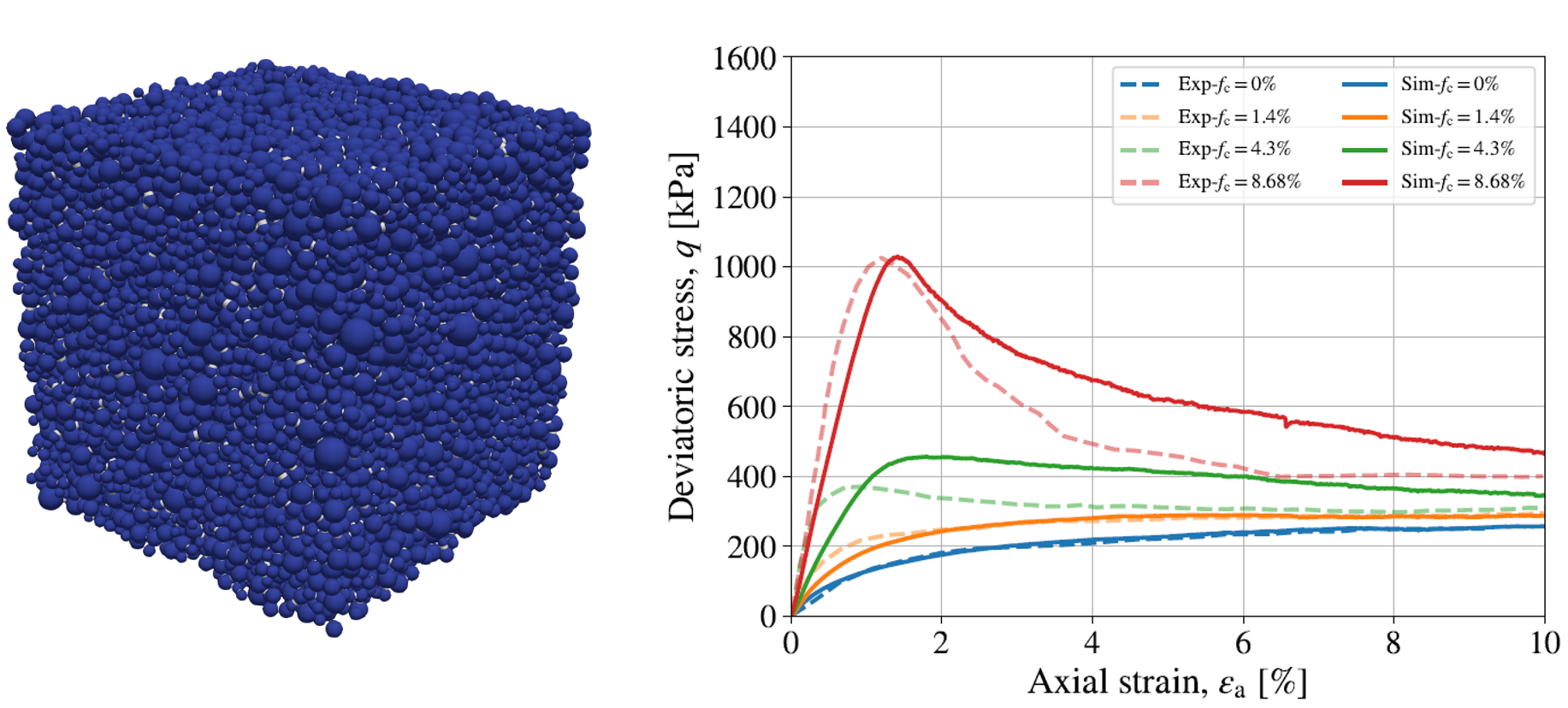
The framework is applied to non-cemented sand, weakly cemented sand, and strongly cemented sand. Biocemented sands are modeled using micro-CT-derived calcite characteristics, while Fontainebleau sandstone is simulated using a physics-based particle overgrowth approach. The results reveal a transition from contact-dominated to bond-dominated behavior with increasing cementation, demonstrating the robustness and generality of the proposed framework.
PhD Advisors:
CANDIDATE
 Mr Chengshun Shang is a PhD candidate in Structural Analysis at CIMNE’s Structural and Particle Mechanics research cluster. He holds a BSc in Mining Engineering and an MSc in Geotechnical Engineering from SDUST and SDU (China). His research focuses on particle-based numerical methods for cemented geomaterials.