

Eugenio Oñate
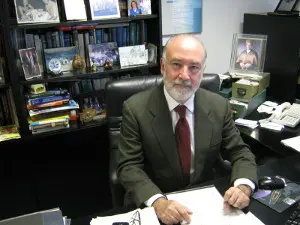
Married. Three children.
Professor of Structural Mechanics.
School of Civil Engineering. Technical University of Catalonia.
Scientific Director of Severo Ochoa Program of Excelence
International Centre for Numerical Methods in Engineering (CIMNE)
Barcelona, Spain
Academic Degrees
| 1976 | Master in Science, Civil Engineering Dept., Univ. College of Swansea, Gales |
| 1979 | Doctor in Philosophy (Ph.D.), Univ. College of Swansea, Gales. Director de Tesis: Prof. O.C. Zienkiewicz |
| 1979 | Doctor Ingeniero de Caminos, Canales y Puertos, Univ. Politécnica de Cataluña (por convalidación de Ph.D.) |
Professional Activities
After completing a degree in Civil Engineering in July 1975 at the Technical Univ. of Valencia (Spain), he started postgraduate studies at the Civil Engineering Dept. of Swansea University, Wales, UK. There he completed in June 1976 a Master of Science degree (M.Sc. Thesis on Development of a finite strip method for analysis of bridges and folded plate structures) and later a Ph.D. degree (Dec. 1978) under the supervision of Prof. O. C. Zienkiewicz (Ph. D. Thesis on Plastic flow in metals with special reference to: I) Coupled thermal flow. II) Thin sheet metal forming). His Ph.D. studies were funded by an Alcoa Research Grant from USA.
In February 1979 he moved to the Technical University of Catalunya (UPC) in Barcelona, Spain, where he was hired as an Associated Professor on Structural Mechanics at the School of Civil Engineering. He became a Full Professor with tenure on June 1983. From March 1983 to March 1989 he was the Director of the School of Civil Engineering at UPC. During that period and under his personal supervision the new premises of the Civil Engineering School (? 20.000 m2) were designed and built in the new campus of UPC.
On March 1987 he founded CIMNE (International Center for Numerical Methods in Engineering, www.cimne.com), a research center specialized in the development and application of numerical methods in engineering. This center has grown to employ some 250 scientists and engineers from 25 different countries worldwide specialized in research activities in different fields of engineering and science (civil, mechanical, aerospace and naval engineering, bio-medical engineering, food engineering, etc.). CIMNE has received many prestigious Awards in Cataluña and by the European Commission.
In 2002 he created the CIMNE Classroom Network. The CIMNE Classrooms are physical spaces jointly created by CIMNE and a University for the development of training, research and technology transfer activities (see www.cimne.com for further details). The CIMNE Classroom Network incorporates nowadays 30 centers created between CIMNE and universities in Spain and in several Latin American countries (Argentina, Brasil, Chile, Colombia, Cuba, El Salvador, Guatemala, Mexico and Peru). The CIMNE Classrooms are a unique instrument for scientific and technical cooperation between research, academic and industrial organizations in Europe and Latin-American.
Has supervised 73 Ph.D. Theses and 115 Master Theses. 57 of his former students are now full professors in Universities in Spain (22), UK (2), other European countries (9), USA (6), Asia-Pacific (3) and Latin America (15). He has had a significant impact in the creation of new scientific groups in cooperation with his former students.
In 1989 he was the founder and first President of the Spanish Association for Numerical Methods in Engineering (SEMNI, www.cimne.upc.es/semni). Under his presidency (1989- 2004) SEMNI became the largest association in Europe in the field of Numerical Methods in Engineering. SEMNI has organized 8 congresses in the field. On June 2004 he was appointed Honorary President of SEMNI. In July 2005 he was appointed Honorary Member of the Portuguese Association of Theoretical, Applied and Computational Mechanics (APMTAC) as recognition of his work towards the unification of APMTAC and SEMNI conferences which are jointly held since 1983 and typically attract some 400 scientists and engineers.
He was one of the founders and first Vice-President (1993-95) of the European Community on Computational Methods in Applied Sciences (ECCOMAS, www.eccomas.org). In the period 2000-2004 he was the President of ECCOMAS. On September 2000 he organized the third ECCOMAS Congress in Barcelona which attracted some 1500 participants.
In the period 1994-2002 he was the Secretary General of the International Association for Computational Mechanics (IACM, www.iacm.info). Since September 2002 he is the President of the IACM. On July 2006 he was re-elected as President of the IACM for a new four year period. During his mandate as Secretary General and President of IACM he has supervised the organization of the World Congresses of Computational Mechanics of the IACM held in Tokyo (1994), Buenos Aires (1998), Vienna (2002), Peking (2004), Los Angeles (2006), Venice (2008) and Sidney (2010).
His research activities have spread over a range of multidisciplinary fields which he has contributed relevant theories and methods of scientific and industrial relevance. His key research lines are the following:
– Development of innovative finite element methods for analysis and optimal design of structures with standard and composite materials . Applications to shells, buildings, dams, bridges, tunnels, harbours, geomechanics, inflatable structures and vehicle structures (cars, airplanes, trains, ships).
– New rotation-free triangular finite elements for analysis of plate and shell structures .
– New stabilized finite element methods based on finite calculus for fluids and incompressible solids.
– Development of innovative numerical methods for optimal design of manufacturing processes . Applications to sheet metal forming, casting, forging, rolling and extrusion of metallic products.
– Development of innovative numerical methods combining particle-based methods, discrete element methods and finite element methods for coupled problems in engineering . Applications to aeroelastic analysis of airplanes and flexible structures (tall buildings, slender bridges and aero-generator blades); hydrodynamic analysis of ships; fluid-structure interaction problems with application to harbour and marine engineering and to constructions under flooding situations; excavation problems in civil and mining engineering and coupled thermalflows in industrial and environmental problems.
– Modelling and simulation of the melting and burning of objects with the particle finite element method .
– Development of decision support systems in engineering integrating data-bases, numerical methods, wireless sensors and artificial intelligence techniques. Applications to the risk prediction and management of floods, sea spills , energy consumption in cities and bio-medical engineering.
The above research lines have been developed in the framework of over 900 RTD projects carried out in cooperation with the main engineering companies in Spain and worldwide. Some 150 of these projects have been developed in the framework of EC programmes.
In parallel with the RTD activities, Eugenio Oñate has organized as chair person 45 international congresses on topics closely related with the above RTD lines. See list of congresses in www.cimne.com .
He has published 399 papers in scientific journals. He has written 4 text books and is the editor of 60 books in different topics of Computational Engineering Mechanics. He is the editor of three scientific journals (one of which is published by Springer) and 3 books series in Computational Mechanics. He is the author of 71 chapters in books, 67 monographs, 627 papers in conference proceedings and 241 research reports .
PUBLICATIONS
He has published 491 papers in JCR journals with 19117 (35658) citations (information at 10.09.2024). He has an h index of 67 (87). Citations and h-index source: First number: Scopus, In brackets: Google Scholar. He has published 251 papers in Q1 and 201 papers in D1 (source: Scopus).
No. OF PAPERS IN TERMS OF CITATIONS (C)
Google Scholar (Scopus): 20 < C ≤ 50, 179 (100) papers; 50 < C ≤ 150, 112 (72) papers; 150< C≤ 300, 23 (13) papers; 300< C≤ 1000, 14 (3) papers, 1000< C, 3 (1) papers. One paper cited 3682 times (Scopus).
He is regularly invited to deliver Keynote (Plenary) Lectures in the main International Conferences in Computational Engineering Science (45 Plenary Lectures and 40 Keynote lectures in the last 35 years).
His research work has been recognized in many Prizes and Awards.
LEADERSHIP IN INDUSTRIAL INNOVATION. In addition, to his scientific activity he has developed an intensive task in the transfer of the outcome of his research to the industrial sector. He has been personally involved in the creation of several spin-off companies in Spain. These companies are operating with success in the international market distributing and applying software products and practical outcomes derived from the research at CIMNE. He has launched 19 spin-off companies in Spain: 6 prior to 2008 and 13 in 2010-2021 (www.cimne.com/vpage/2/0/Technology/Spin-off-Companies). The more successful of the initial set of companies are: Structuralia ( www.structuralia.com ) specialized in e-learning services for the construction sector (sold to the Kaplan Group (US) in 2010) ; COMPASS ( www.compassis.com ) specialized in software for naval and construction sectors; Quantech ATZ ( www.quantech.es ) specialized in software for manufacturing and aerospace sectors; BuildAir ( www.buildair.com ) specialized in design and construction of textile membrane and inflatable structures (sold in 2022) and INGENIA ( www.ingenia.aero ) specialized in consulting services in aeronautics.
In 2011 he created CIMNE Tecnología. SA (www.cimnetecnologia.com) specialized in the transfer to market of CIMNE outputs. In 2011-2021 this company created 11 spin-off companies. Among these we note: Lyncos SL (2012) (Internet of Things; www.lhings.com ), Energy Management Systems SL (www.inergybcn.com), PMS SL (2013) (inflatable multimedia pavilions, www.portablemultimediasolutions.com), Pneumatic Structures Technology SL (2015) (www.ps-technologies.com); Fresh Water Nature S.L. (2014) (desalinization & purification of sea and waste water, www.freshwaternature.com); Inloc Robotics SL(2015) (www.inlocrobotics.com), Scipedia SL (2016) (open science publishing, www.scipedia.com) and OKTICS (2019) (digital signage technology, www.okobusiness.com). The CIMNE spin-off companies fostered by E. Oñate employ 175 workers, including 19 Post-Docs (info at December 20th 2022).
| LIST OF COMPANIES AND RESEARCH LINES | ||||
| Aerodinámica | Vehículo espacial HERMES | Dassault Aviation | ||
| Aviones supersónicos | NASA, CASA | |||
| Aerodinámica del Gran Telescopio de Canarias | Grantecan | |||
| Aerodinámica de coches | SEAT | |||
| Análisis de estructuras históricas | Basílica de San Marcos de Venecia | Comunidad Europea | ||
| Catedrales de Barcelona y Tarragona | Comunidad Europea | |||
| Análisis de procesos de conformado de metales | Embutición de chapa | ALCOA, ENSIDESA | ||
| Fundición | Metal Box, Candemat | |||
| Laminación en caliente | Mikalor, Decad, Metalpack, Renault,CastingRos,Metalogenia | |||
| Análisis hidrodinámico de barcos y estructuras en el mar | Rioja de España (Copa América) | CADESA, IZAR | ||
| Barcos rápidos, Fragatas | Alfa Marin, Com. Europea | |||
| Análisis resistente de vehículos | Estudios de impactos en estructuras | PEGASO, GEC ALSTHON | ||
| Análisis de estructuras de vehículos | SEAT, FIAT | |||
| Estudio de fatiga en barcos | IZAR | |||
| Estudio de satélites espaciales | CASA | |||
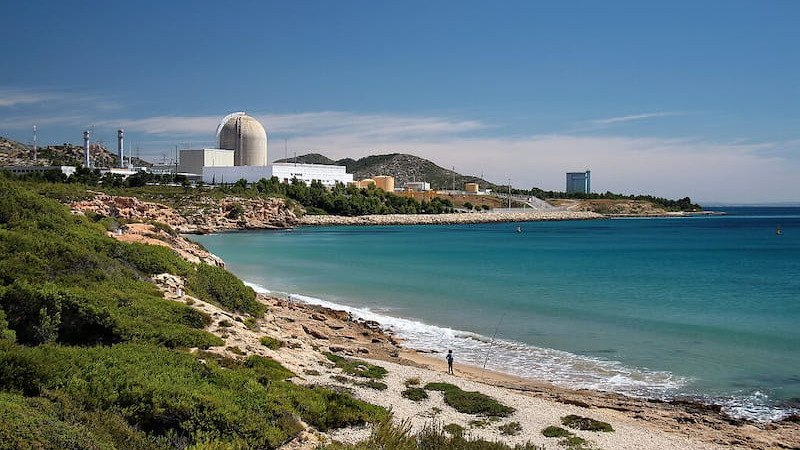
| Cálculo de centrales nucleares | Análisis estático y dinámico del edificio de contención Vandellós II | Asociación Nuclear Vandellós | ||
| Cálculo de depósitos | Depósitos de agua pretensados | Hormigones Pretensados S.A. | ||
| Cálculo de presas | Presa de isil (bóveda) | hidroeléctrica de cataluña | ||
| Presa del Limonero (materiales sueltos) | Conf. Hidrográfica del sur | |||
| Presa de Mequinenza (gravedad) | ENHER | |||
| Presa de San Esteban (gravedad) | Iberdrola | |||
| Presa de Talvacchia (bóveda) | ENHER | |||
| Cálculo de puentes | Puentes de la autopista 9 de Julio (Buenos Aires) | Caminos, Edificios y Obras S.A. | ||
| Desarrollo de sistemas multimedia para educación en ingeniería | Desarrollo de un Centro Virtual para educación en ingeniería | Comunidad Europea | ||
| Desarrollo de software educativo | educativos para introducción al análisis matricial de estructuras y al método de los elementos finitos | CIMNE y diversas empresas Comunidad Europea | ||
| Desarrollo de técnicas de Resonancia Magnética Nuclear para control de calidad en alimentos | Control de calidad de naranjas durante el proceso embalaje | DAUMAR, Comunidad Europea | ||
Teaching Activity
| Supervisor of 68 PhD Theses and 95 Master Theses | ||
| 1979 | Course on Structural Analysis | |
| 1980 | Participant in over 350 short courses and seminars in different topics related to Computational Engineering | |
| 1984 | Introduction to the Finite Element Method (Ph.D. Course) | |
| 1985-2004 | Analysis of thermal problems (Ph. D. Course) | |
| 2007-2011 | Director of Master Course on Numerical Methods in Engineering | |
| 2007-2008 | Director of Master Course on Computational Mechanics (Erasmus Mundus Programme of the EC) |
Organization of Conferences
| X International Conference on Computational Methods for Coupled Problems in Science and Engineering (COUPLED PROBLEMS 2023), Chania, Crete, Greece, 5-7 June, 2023 |
| VII International Conference on Particle-Based Methods (PARTICLES 2021), Hamburg, Germany, 4-6 October, 2021 |
| X International Conference on Textile Composites and Inflatable Structures (STRUCTURAL MEMBRANES 2021), Online Format, 13-14 September 2021 |
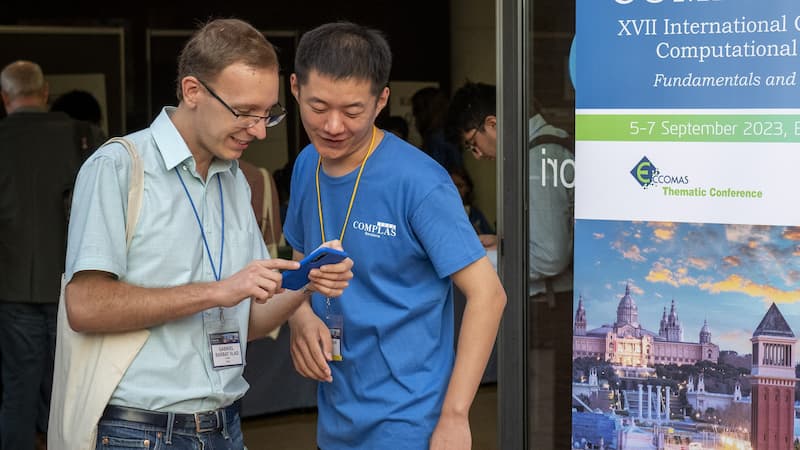
| XVI International Conference on Computational Plasticity (COMPLAS 2021), Barcelona, Spain, 7-9 September 2021 |
| IX International Conference on Coupled Problems in Science and Engineering (COUPLED PROBLEMS 2021), Chia Laguna, South Sardinia, Italy, 13-16 June, 2021 |
| VI International Conference on Particle-Based Methods, (PARTICLES 2019), Barcelona, Spain, 28-30 October 2019 |
| IX International Conference on Textile Composites and Inflatable Structures (STRUCTURAL MEMBRANES 2019) , Barcelona, Spain, 7-10 October 2019 |
| XV International Conference on Computational Plasticity (COMPLAS 2019), Barcelona, Spain, 3-5 September 2019 |
| VIII International Conference on Coupled Problems in Science and Engineering (COUPLED PROBLEMS 2019), Sitges, Spain, 3-5 June 2019 |
| VIII International Conference on Textile Composites and Inflatable Structures (STRUCTURAL MEMBRANES 2017), Munich, Germany, 8-11 October 2017 |
| V International Conference on Particle-Based Methods (PARTICLES 2017), Hannover, Germany, 26-28 September 2017 |
| XIV International Conference on Computational Plasticity (COMPLAS 2017), Barcelona, Spain, 5-7 September 2017 |
| VII International Conference on Coupled Problems in Science and Engineering (COUPLED PROBLEMS 2017), Rhodes Island, Greece, 12-14 June 2017 |
| XI World Congress on Computational Mechanics (WCCM XI), Barcelona, Spain, 20-25 July 2014 |
| VII International Conference on Textile Composites and Inflatable Structures (STRUCTURAL MEMBRANES 2015), Barcelona, Spain, 19-21 October 2015 |
| IV International Conference on Particle-based Methods (PARTICLES 2015), Barcelona, Spain, 28-30 September 2015 |
| XIII International Conference on Computational Plasticity (COMPLAS 2015), Barcelona, Spain, 1-3 September 2015 |
| VI International Conference on Computational Methods in Marine Engineering (MARINE 2015), Rome, Italy, 15-17 June 2015 |
| VI Computational Methods for Coupled Problems in Science and Engineering (COUPLED PROBLEMS 2015), Venice, Italy, 18-20 May, 2015 |
| VI International Conference on Textile Composites and Inflatable Structures (STRUCTURAL MEMBRANES 2013), Munich, Germany, 9-11 October 2013 |
| III International Conference on Particle-Based Methods (PARTICLES 2013), Stuttgart, Germany, 18-20 September 2013 |
| XII International Conference on Computational Plasticity (COMPLAS 2013), Barcelona, Spain, 3-5 September 2013 |
| V International Conference on Coupled Problems in Science and Engineering (COUPLED PROBLEMS 2013), Ibiza, Spain, June 17-19 2013 |
| V International Conference on Computational Methods in Marine Engineering (MARINE 2013), Hamburg, Germany, 29-30 May 2013 |
| IV Computational Methods for Coupled Problems in Science and Engineering (COUPLED PROBLEMS 2011), Kos Island, Greece, 20-22 June 2011 |
| XI International Conference on Computational Plasticity (COMPLAS 2011), Barcelona, Spain, 7-9 September 2011 |
| V International Conference on Textile Composites and Inflatable Structures (STRUCTURAL MEMBRANES 2011), Barcelona, Spain, 5-7 October 2011 |
| IV International Conference on Computational Methods in Marine (MARINE 2011), Lisbon, Portugal, 28-30 September 2011 |
| V Conference on Advances and Applications of GiD & 1st Kratos Workshop, Barcelona, Spain, 26-27 May 2010 |
| III Computational Methods for Coupled Problems in Science and Engineering (COUPLED PROBLEMS 2009), Ischia Island, Italy, 8-11 June, 2009 |
| Computational Methods in Marine Engineering (MARINE 2009), Trondheim, Norway, 15-17 June, 2009 |
| X International Conference on Computational Plasticity (COMPLAS 2009), Barcelona, Spain, 2-4 September 2009 |
| International Conference on Particle-Based methods (PARTICLES 2009), Barcelona, Spain, 25-27 November 2009 |
| IV International Conference on Textile Composites and Inflatable Structures (STRUCTURAL MEMBRANES 2009), Stuttgart, Germany, 5-7 October 2009 |
| IX Congreso de Métodos Numéricos en Ingeniería, Barcelona, España, 29 Junio – 2 Julio 2009 |
| II Computational Methods for Coupled Problems in Science and Engineering (COUPLED PROBLEMS 2007), Ibiza Island, Spain 21-23 May, 2007 |
| Computational Methods in Marine Engineering (MARINE 2007), Barcelona, Spain, 4-6 June, 2007 |
| IX International Conference on Computational Plasticity (COMPLAS 2007), Barcelona, Spain, 5-7 September 2007 |
| III International Conference on Textile Composites and Inflatable Structures (STRUCTURAL MEMBRANES 2007), Barcelona, Spain, 17-19 September 2007 |
| International Conference on Adaptive Modeling and Simulation (ADMOS 2007), Göteborg, Sweden, 26-28 September 2007 |
| III European Conference on Computational Solid and Structural Mechanics (ECCSSM’06), Lisbon, Portugal, 5-8 June 2006 |
| European Congress on Computational Fluid Dynamics (ECCOMAS CFD 2006), Egmond aan Zee, The Netherlands, 5-8 September 2006 |
| VIII International Conference on Computational Plasticity (COMPLAS 2005), Barcelona, España, 5-8 IX 2005 |
| I Computational Methods for Coupled Problems in Science and Engineering (COUPLED PROBLEMS 2005), Santorini Island, Greece, 25-28 May, 2005 |
| Computational Methods in Marine Engineering (MARINE 2005), Oslo, Norway, 27-29 June, 2005 |
| International Conference on Adaptive Modeling and Simulation (ADMOS 2005), Barcelona, Spain, 8-10 September 2005 |
| II International Conference on Textile Composites and Inflatable Structures (STRUCTURAL MEMBRANES 2005), Stuttgart, Germany, 2-4 October 2005, Stuttgart, Germany, 2-4 October 2005 |
| VII Congreso de Métodos Numéricos en Ingeniería, Granada, España, 4-7 Julio 2005 |
| I Congreso Nacional III Congreso Internacionadl de Métodos Numéricos en Ingeniería y Ciencias Aplicadas (MONTERREY 2004), Monterrey, México, 22–24 Enero 2004 |
| International Conference on Textile Composites and Inflatable Structures (STRUCTURAL MEMBRANES 2003), Barcelona, España, 30 June – 3 July 2003 |
| VII International Conference on Computational Plasticity (COMPLAS 2003), Barcelona, España, 7-10 Abril 2003 |
| II Congreso Internacional de Métodos Numéricos en Ingeniería y Ciencias Aplicadas, Guanajuato, México, 17-19 Enero 2002 |
| V Congreso de Métodos Numéricos en Ingeniería, Madrid, España, 3-6 Junio 2002 |
| I Congreso sobre Métodos Numéricos en Ciencias Sociales (MENCIS 2000), Barcelona, España, 20-21 Noviembre 2000 |
| VIII European Turbulence Conference, Barcelona, Spain, 27-30 June 2000 |
| VI International Conference on Computational Plasticity: Fundamentals and Applications (COMPLAS 2000), Barcelona, Spain, 11-14 September 2000 |
| European Congress on Computational Methods in Applied Science and Engineering (ECCOMAS 2000), Barcelona, Spain, 11-14 September 2000 |
| IV Congreso sobre Métodos Numéricos en Ingeniería, Sevilla, España, 7-10 Junio 1999 |
| IV World Congress on Computational Mechanics, Buenos Aires, Argentina, 29 June – 2 July 1998 |
| V International Conference on Computational Plasticity: Fundamentals and Applications (COMPLAS 1997), Barcelona, Spain, 17-20 March 1997 |
| III Congreso sobre Métodos Numéricos en Ingeniería, Zaragoza, España, 3-6 Junio 1996 |
| IV International Conference on Computational Plasticity. Fundamentals and Applications (COMPLAS 1995), Barcelona, Spain, 3-6 April 1995 |
| International Seminar on Structural Analysis of Historical Constructions, Barcelona, Spain, 8-10 November 1995 |
| II Congreso sobre Métodos Numéricos en Ingeniería, La Coruña, España, 7-11 Junio 1993 |
| VIII International Conference on Finite Elements in Fluids. New Trands and Applications (FEMIF’93), Barcelona, Spain, 20-24 September 1993 |
| International Congress on Numerical Methods in Engineering and Applied Sciences, Concepción, Chile, 16-20 November 1992 |
| III International Conference on Computational Plasticity. Fundamentals and Applications (COMPLAS 1992), Barcelona, Spain, 6-10 April 1992 |
| International Conference on Parallel Computing and Transputer Applications (PACTA’92), Barcelona, Spain, 21-24 September 1992 |
| Computer Aided Training in Science and Technology (CATS’90), Barcelona, Spain, 8-12 July 1990 |
| II International Conference on Computational Plasticity. Models, Software and Applications (COMPLAS 1989), Barcelona, Spain, 18-22 September 1989 |
| I International Conference on Computational Plasticity, Models, Software and Applications (COMPLAS 1987), Barcelona, Spain, 6-10 April 1987 |
RTD Projects and Technology Transfer Activities
| He has taken part in over 400 RTD projects in cooperation with some 200 enterprises in Spain and worldwide. 110 of these projects were carried out in the framework of research programmes of the European Commission (EC). The RTD projects typically focussed in the development of numerical methods for the solution of problems in civil, aerospace, mechanical and naval engineering.
He has promoted the creation of 8 spin-off companies. The core activity of these companies in Spain is the application and marketing the software technology developed by his group via RTD projects |
Research Lines
| – Innovative rotation-free triangular elements for analysis of plate and shell structures | |
| – New finite element (FE) methods for analysis and optimal design of structures with composite materials | |
| – New numerical techniques combining particle-based methods, discrete element methods and FE methods for multidisciplinary engineering problems | |
| – Innovative numerical methods for simulation and optimal design of manufacturing processes | |
| – New stabilized finite element methods for fluid mechanics, convective transport and incompressible solids | |
| – Modelling and simulation of the melting and burning of objects in fire | |
| – Integration of decision support systems in engineering |
Academic and Scientific Positions
| 1979- | Associated Professor in Structural and Continuum Mechanics at Technical Univ. of Catalonia (UPC) |
| 1981- | Full Professor in Structural Mechanics, Universidad Politécnica de Catalunya (UPC) |
| 1983-89 | Director of School of Civil Engineering, UPC |
| 1987- 2022 |
Founder, Executive Vicepresident, and Director of International Center for Numerical Methods in Engineering (CIMNE) |
| 1989-2004 | President of the Spanish Society for Numerical Methods in Engineering (SEMNI) |
| 1992-95 | President of the Scientif Council of the Center for Supercomputing of Catalonia (CESCA) |
| 1992-95 | Director of Structural Mechanics Department at UPC |
| 1993-96 | Vice-president of European Community on Computational Methods in Applied Sciences (ECCOMAS) |
| 1994-2002 | General Secretary of the International Association for Computational Mechanics (IACM) |
| 1998 | Member of the Royal Academy of Doctors. Barcelona |
| 2000-2004 | President of the European Community on Computational Methods in Applied Sciences (ECCOMAS) |
| 2002-2010 | President of the International Association for Computational Mechanics (IACM) |
| 2004- | Honorary President of Spanish Association for Numerical Methods in Engineering (SEMNI) |
| 2005 | Honorary Member of Portuguese Assoc. for Theoretical, Applied and Computational Mechanics (APMTAC) |
| 2006 | Foreign Member of the Accademia di Scienze e Lettere, Istituto Lombardo, Milan (Italy) |
Phd Students
Ongoing Theses Supervised by E. Oñate
| Karen Lorena Caselles, Finite element methods for solid-pore fluid coupled problems in multi-fractured porous media. Universitat Politècnica de Catalunya (UPC). Co-supervised with Dr. Ignasi de Pouplana. |
| Varadaraju Gandikota, FE-DEM procedure for multi-fracture analysis of rock in all/gas exploration processes. Universitat Politècnica de Catalunya (UPC). Co-supervised with Dr. Francisco Zárate. |
| Alireza Taherzadeh, On the study of delamination and failure of composite materials under static and cyclic loads. Universitat Politècnica de Catalunya (UPC). Co-supervised with Dr. Lucia Barbu. |
Completed PhD Theses Supervised by E. Oñate
| Javier Oliver, A quasi intrinsic formulation for the finite element analysis of arches, plates and shells under large displacement in the elastoplastic regime, Universitat Politècnica de Catalunya, March 1982 |
| Benjamín Suárez, A finite strep formulation using Reissner-Mindlin theory for análisis of plates, bridges and axisymetric shells, Universitat Politècnica de Catalunya, June 1982 |
| Luis Pérez, Contribution to the dynamic analysis of structures. Free vibration of bridges and axisymetric plates using the finite strip method, Universitat Politècnica de Catalunya, July 1982 |
| Elena Blanco, Theoretical-experimental study of the influence of transverse shear in skew slabs, Universitat Politècnica de Catalunya, April 1986 |
| Sergio Oller, Plastic damage models for frictional materials, Universitat Politècnica de Catalunya, May 1988 |
| Carlos Agelet de Saracibar, A viscous shell formulation for sheet stamping processes, Universitat Politècnica de Catalunya, June 1990 |
| Reza Attarnejad, A finite element model for analysis of shells under static and dynamic loads, Universitat Politècnica de Catalunya, June 1990 |
| Ramón Codina, Finite element Petrov-Galerkin formulation for incompressible flows, Universitat Politècnica de Catalunya, June 1992 |
| Salvador Botello, Analysis of multi-layer composite shells using the finite element method, Universitat Politècnica de Catalunya, June 1993 |
| Fernando A. Quintana, A finite element formulation for analysis of compressible flows, Universitat Politècnica de Catalunya, July 1993 |
| Fernando Escalante, A methodology for computer aided training in structural engineering, Universitat Politècnica de Catalunya, 1993 |
| Diego Celentano, A thermo mechanical model for solidification problems in metals, Universitat Politècnica de Catalunya, 1994 |
| Marcela Cruchaga , A finite element model for incompressible flow problems with free surface, Universitat Politècnica de Catalunya, June 1996 |
| Thomas R. Fischer, A contribution to adaptive numerical solution of compressible flow problems, Universitat Politècnica de Catalunya, June 1996 |
| Patricio Cendoya, New finite element methods for elastoplastic dynamic analysis of shell structures, Universitat Politècnica de Catalunya, June 1996 |
| Francisco Zárate, New triangular finite element for plates and shells, Universitat Politècnica de Catalunya, July 1996 |
| William M. Taylor, The critical displacement method for structural instability analysis, Universitat Politècnica de Catalunya, September 1996 |
| Lluis Gil, Sensitivity analysis for non linear material models. Application to structural design, Universitat Politècnica de Catalunya, December 1996 |
| Alexandru Hanganu, Non linear static and dynamic analysis of reinforced concrete structures using damage models, Universitat Politècnica de Catalunya, June 1997 |
| Josefa Estupiñán, Evolutionary methods for topology optimization, Universitat Politècnica de Catalunya, December 1997 |
| Jasmina Jovicevic, Analysis of structural stability problems by the finite element method, Universitat Politècnica de Catalunya, January 1998 |
| Julio García, Analysis of coupled fluid-structure interaction problems in ship hydrodynamics, Universitat Politècnica de Catalunya, November 1999 |
| Eduardo J. Car, A continuum constitutive model for the analysis of composite materials, Universitat Politècnica de Catalunya, March 2000 |
| Ramon Ribó, Development of an integrated system for geometrical modelling, mesh and data generation for finite element analysis, Universitat Politècnica de Catalunya, March 2000 |
| Carlos Sacco, The finite point method in fluid dynamics, Universitat Politècnica de Catalunya, March 2002 |
| Franco Perazzo, A meshless finite point method for elasticity problems using the finite point method, Universitat Politècnica de Catalunya, February 2003 |
| Antonio Morán, Secant and tangent finite element formulations for Cosserat beams, Universitat Politècnica de Catalunya, May 2005 |
| Romain Aubry, New lagrangian formulations for analysis of the interaction between structures and fluid, Universitat Politècnica de Catalunya, March 2006 |
| Fernando Rastellini, New numerical methods for analysis of fatigue life of structures with composite materials, Universitat Politècnica de Catalunya, June 2006 |
| Pooyan Dadvand, Development of finite element methods to solve coupled fluid-structure interaction problems, Universitat Politècnica de Catalunya, July 2007 |
| Henrik Lynga, New numerical methods for the analysis of rigid-flexible structures under wind loading, Universitat Politècnica de Catalunya, September 2007 |
| Gerardo Valdés, Nonlinear analysis of orthotropic membrane and shell structures including fluid-structure interaction, Universitat Politècnica de Catalunya, November 2007 |
| Daniel Di Capua , Análisis de estructuras de hormigón armado expuestas al fuego, Universitat Politècnica de Catalunya, January 2009 |
| Roberto López , Desarrollo de redes neuronales para sistemas de ayuda a la decisión en ingeniería, Universitat Politècnica de Catalunya, January 2009 |
| Josep Mª Carbonell, Modeling of Ground Excavation with the Particle Finite Element Method, Universitat Politècnica de Catalunya, December 2009 |
| Mónica de Mier, A formulation for mixture problems based on the particle finite element method, Universitat Politècnica de Catalunya, June 2010 |
| Pavel Ryzhakov, Lagrangian FE methods for coupled problems in fluid mechanics, Universitat Politècnica de Catalunya, July 2010 |
| Rubén Otín , Regularized Maxwell equations and nodal finite elements for electromagnetic field computations in frequency domain, Universitat Politècnica de Catalunya, May 2011 |
| Prashant Nadukandi, Development of stabilization methods in convective transport problems using finite calculus, Universitat Politècnica de Catalunya, May 2011 |
| Pablo E. Vargas, Formulación de elementos finitos para vigas de sección abierta en laminados compuestos, Universitat Politècnica de Catalunya, January 2012 |
| Antonia Larese, Instability analysis of earth dams due to overspills by the particle finite element method, Universitat Politècnica de Catalunya, July 2012 |
| Carlos Labra, Particle methods for mining engineering problems, Universitat Politècnica de Catalunya, July 2012 |
| Virginia Monteiro, Computational model of the human urinary bladder, Universitat Politècnica de Catalunya, June 2013 |
| Kazem Kamran, Development of stabilization techniques for numerical analysis of incompressible mechanics, Universitat Politècnica de Catalunya, June 2013 |
| Xavier Diego, On the theory of cell migration: durotaxis and chemotaxis, Universitat Politècnica de Catalunya, July 2013 |
| Mohammad Kouhi, Aerodynamic shape optimization using adaptive remeshing, Universitat Politècnica de Catalunya, September 2013 |
| Enrique Ortega, Development and applications of the Finite Point Method to compressible aerodynamics problems, Universitat Politècnica de Catalunya, May 2014 |
| Abel Coll, Advances in the generation of nonstructured meshes, Universitat Politècnica de Catalunya, July 2014 |
| Ariel Eijo, Finite element modelling of delamination in advanced composite beams and plates using one- and two-dimensional finite elements based on the refined zigzag theory, Universitat Politècnica de Catalunya, September 2014 |
| Alessandro Franci, Unified Lagrangian formulation for fluid and solid mechanics, fluid-structure interaction and coupled thermal problems using de PFEM, Universitat Politècnica de Catalunya, May 2015 |
| Pablo Becker, An enhanced Particle Finite Element Method with special emphasis on landslides and debris flows, Universitat Politècnica de Catalunya, July 2015 |
| Jordi Cotela, Applications of turbulence modeling in civil engineering, Universitat Politècnica de Catalunya, January 2016 |
| Nelson Lafontaine, Modelado de multifractura discreta en materiales quasi-frágiles, Universitat Politècnica de Catalunya, January 2016 |
| Eduardo Soudah, Computational fluid dynamics indicators to improve cardiovascular pathologies, Universitat Politècnica de Catalunya, February 2016 |
| Carles Estruch, Nuevo concepto de puente de vigas hinchables ligero, modular y portátil, Universitat Politècnica de Catalunya, July 2016 |
| Miquel Santasusana, Numerical techniques for non-linear analysis of structures combining discrete element and finite element methods , Universitat Politècnica de Catalunya, December 2016 |
| Fernando Salazar, A machine learning based methodology for anomaly detection in dam behaviour, Universitat Politècnica de Catalunya, February 2017 |
| Joaquín Irazábal, Numerical analysis of railway ballast behaviour using the Discrete Element Method, Universitat Politècnica de Catalunya, October 2017 |
| Ignasi De Pouplana, Development of new computational methods for fluid-structure interaction analysis of multi-fractured media, Universitat Politècnica de Catalunya, January 2018 |
| Victor Eduardo Cardoso, Discrete Volume Method. A variational approach for brittle fracture, Universitat Politècnica de Catalunya, April 2018 |
| Guillermo Casas, Numerical analysis of particle-laden flows with the finite element method, Universitat Politècnica de Catalunya, October 2018 |
| Miguel Angel Celigueta, A Particle Finite Element Method for fluid-related problems in civil engineering, Universitat Politècnica de Catalunya, November 2019 |
| Ilaria Iaconeta, Discrete-continuum hybrid modelling of flowing and static regimes, Universitat Politècnica de Catalunya, November 2019 |
| Vicente Mataix, Innovative mathematical and numerical models for studying the deformation of shells during industrial forming processes with the finite element method, Universitat Politècnica de Catalunya, September 2020 |
| Rubén Zorrilla, Towards the Virtual Wind Tunnel for civil engineering applications, Universitat Politècnica de Catalunya, September 2020 |
| Pere-Andreu Ubach, Finite element analysis of membrane structures, Universitat Politècnica de Catalunya, November 2020 |
| Alejandro Cornejo, A fully Lagrangian formulation for fluid-structure interaction between free-surface flows and multi-fracturing solids, Universitat Politècnica de Catalunya, December 2020 |
| Albert Puigferrat, Finite Element Methods for advection-diffusion-absorption and fluid flow problems, Universitat Politècnica de Catalunya, July 2021 |
| Miguel Masó, Coupling Shallow Water Models with Three-Dimensional Models for the Study of Fluid-Structure Interaction Problems Using the Particle Finite Element Method, Universitat Politècnica de Catalunya, September 2022 |
| Felipe Muñoz-La Rivera, Framework For An EXtended Reality (XR) Solution For Holistic Safety Management In Construction, Universitat Politècnica de Catalunya, March 2023 |
| Sergio Jiménez, Development of a unified fatigue constitutive model: from high to low cycle regime. Universitat Politècnica de Catalunya, April 2024 |
| Rafael Rangel, A continuous and discrete coupled analysis for regulating heat transfer using granular materials. Universitat Politècnica de Catalunya (UPC). Co-supervised with Dr. Alessandro Franci, 2024 |
| Hadi Bakhshan, Numerical modeling of ultrasonic vibration-assisted machining process using particle finite element method. Universitat de Vic. Co-supervised with Dr. Josep Maria Carbonell, 2024 |
| Total: 73 PhD Theses |
Prizes, Awards and Recognitions
Other Merits
| Director of 73 Doctoral Theses | |
| Member of the Editorial Board of 25 international journals. | |
| Organiser of 29 international conferences in the field of Computational Mechanics since 1980. | |
| 1989 | Member of the Scientific Committee of the International Association for Computational Mechanics (IACM). |
| 1989-91 | Member of the Scientific Committee of the Centre de Structures et Materiaux of the Escuela Superior de Minas of Paris. |
| 1989-95 | Member of the Scientific Committee of the Instituto Mediterráneo de Tecnología of Marsella. |
| 2003 | Special Invited Prof. of the Universitdad de Las Villas, Santa Clara, Cuba |