


CIMNE researchers Oluwakemi Akinwehinmi and former head of CIMNE-Nature, Dr. Pedro Arnau del Amo, have presented a novel image augmentation technique to enhance the capability of artificial intelligence (AI) models to detect abandoned pets in the wild.
Using cutting-edge techniques to address the challenges of small image datasets, experts designed a detailed implementation methodology that improves the ability of AI deep learning models to better distinguish abandoned pets in the natural environment, increasing precision and recall about 4%.
In a paper presented at the 15th Congress of the International Colour Association in late 2023, the authors applied single-channel image augmentation tailored to monochrome RGB, HSV, and HSL signals to solve common real-world image recognition challenges related to illumination contrasts, occlusion, and scaling.
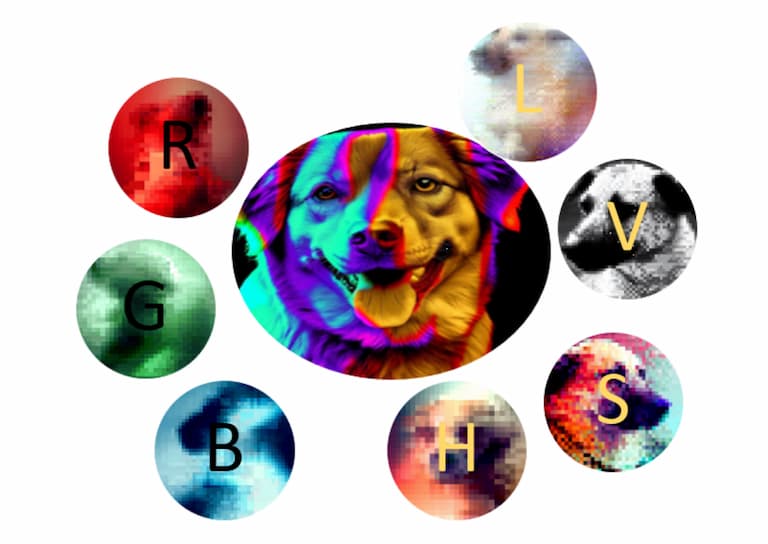
Diagrammatic View of Colour Channels in RGB, HSV and HSL formats.
The work was based on object-oriented design in Convolutional Neural Networks (CNN), a type of deep learning model that can learn to recognize patterns in images. Researchers processed training images for abandoned pet detection using techniques such as CNN-based resizing and colour channel splitting for image augmentation.
The proposed single-coloured image augmentation technique was used to boost the original training dataset of 17,500 animal images to 35,000 single-channel files, demonstrating how a deep learning model trained on the latter, augmented dataset, yielded more precise detection results.
Hundreds of thousands of pets are abandoned every day around the world, according to NGO Four Paws. In Dr. Arnau’s words, advanced image augmentation techniques can “enhance IA capabilities to detect given up house animals in the wild”, potentially allowing for “new automation processes” to make it “faster and cheaper” for rejected pets to find a new home.
The full paper, entitled Improving abandoned pet detection in natural spaces through adaptive single-coloured image augmentation techniques, was authored by PhD student Oluwakemi Akinwehinmi, from the Information and Communication Technology research group, and former CIMNE researcher Prof. Pedro Arnau del Amo. University of Lleida Prof. Xavier Solsona Tehàs is the corresponding author.