MATCAB, an artificial intelligence (AI) traffic management system jointly developed by Kapsch TrafficCom and CIMNE’s Innovation Unit in Transport (CENIT), has been selected as a winning proposal in the fifth Barcelona Innova Lab Mobility Challenge, a competitive event, part of Tomorrow.Mobility expo, held this November in Barcelona.
MATCAB, which stands for Multimodal AI Traffic Control Agent in Barcelona, proposes using AI to constantly monitor road conditions and adapt traffic signals to the most efficient plan, while ensuring consistent decisions across neighbouring junctions. This allows for more harmonised traffic flows that will benefit all road users, like public transport, pedestrians or bikes.
Instead of following the pre-set timing plans of conventional traffic lights, MATCAB combines both sensors and historical data on different transport modes, enabling a more people-centred approach to mobility.
The tool relies on a data harmonisation layer to bring together frequently updated inputs, while AI agents trained through simulation propose real-time adjustments to traffic signals that would improve traffic flows.
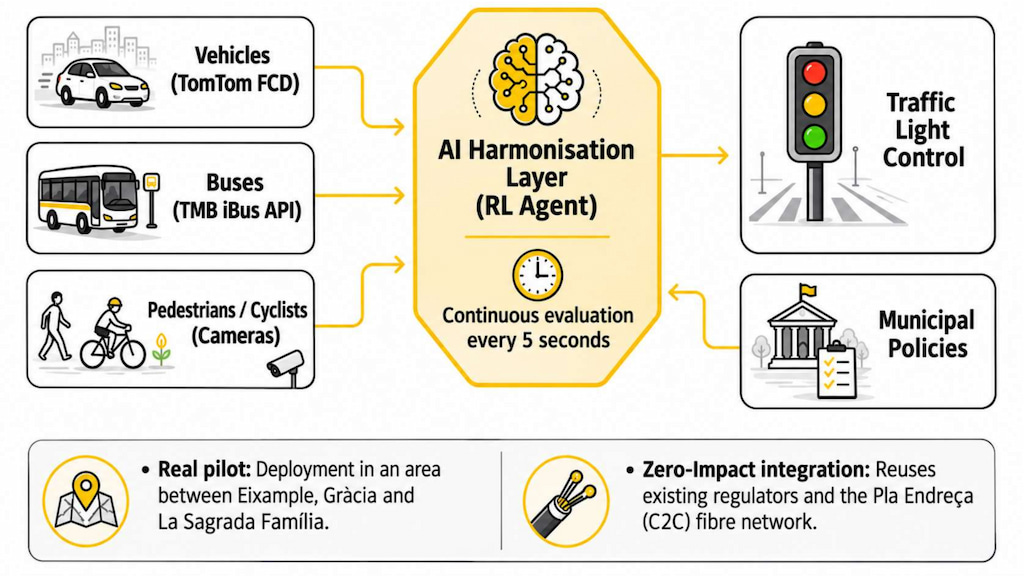
MATCAB combines real-time data from vehicles, public transport and active mobility to support AI-assisted traffic signal management in Barcelona.
Adaptive implementation
MATCAB is designed to integrate with existing signal infrastructure for a low-friction implementation, and will be fully compatible with Kapsch TrafficCom’s EcoTrafiX platform.
To ensure safety, pedestrian crossing times, emergency vehicle priorities and other regulatory requirements cannot be overridden by the AI. In addition, customized and pre-defined plans can also be sent to the involved traffic lights on-demand, according to specific needs by the local authorities.
Relying on CIMNE’s expertise
CIMNE contributes to MATCAB’s technical development through its expertise in data harmonisation and simulation-based model development. Researchers at CENIT, CIMNE’s Innovation Unit in Transport, have decades of experience in traffic modelling, mobility simulation, public transport optimisation and travel behaviour analysis.
Among the CIMNE specialists involved is Francisco Rodero, Innovation Leader and ITS Manager at CENIT, who brings over 20 years of experience in applied research, including urban mobility in Barcelona and its metropolitan area.
“The opportunity is not simply to make traffic lights react faster, but to use available data and simulation to make better decisions for everyone moving around the city,” says Dr. Rodero. “If we can reduce unnecessary waiting, guarantee bus frequency and improve conditions for people walking or cycling, MATCAB can also support reducing emissions and, therefore, a better quality of life.”
Testing MATCAB on Barcelona’s streets
MATCAB is expected to undergo a four-month pilot in 2027 at selected intersections in Barcelona. The trial will examine whether its approach can deliver measurable improvements under real traffic conditions while maintaining the safety and priorities of different road users.
The project’s targets include reducing average waiting times for pedestrians and cyclists by 5% and episodes of severe congestion by 10%. It also seeks more reliable, quicker journeys on key Barcelona bus routes, including line H8, one of the city’s most-used lines in 2024, highlighting the potential reach of improvements to high-demand, cross-city services.
Beyond these targets, the pilot will test how public authorities, industrial technology and applied research can work together to make better use of existing infrastructure. The findings will help inform future approaches to safer, more efficient and more sustainable urban mobility in Barcelona and elsewhere.
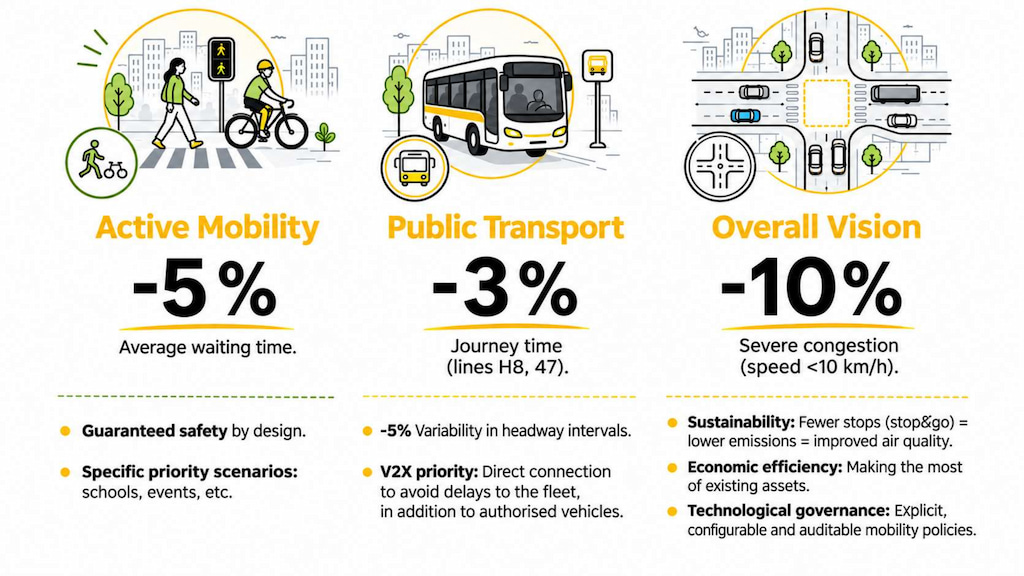
MATCAB aims to reduce waiting times for pedestrians and cyclists, improve bus service reliability and cut episodes of severe traffic congestion.