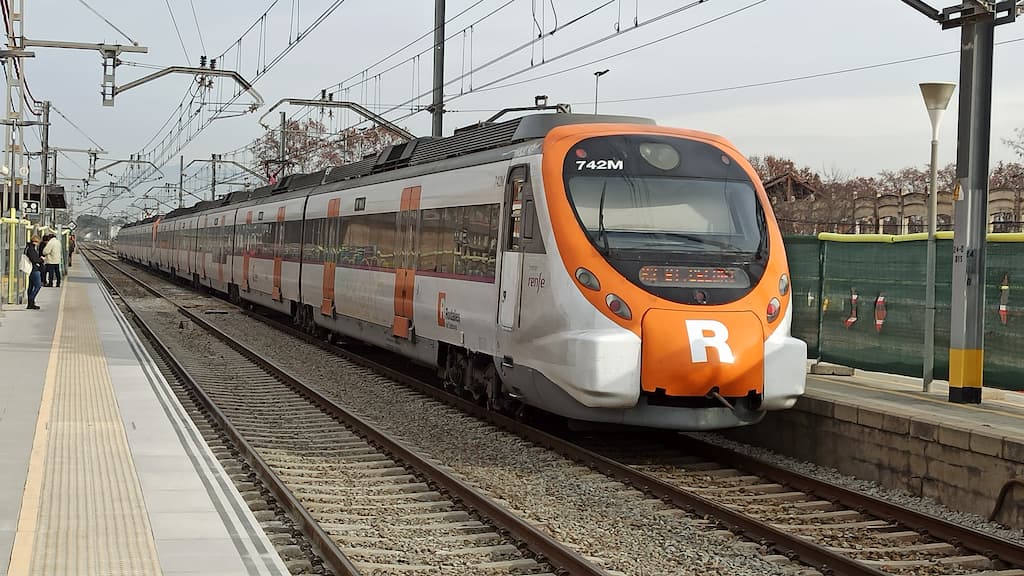
A Rodalies commuter train stops north of Barcelona | Source: Wikimedia Commons / Iguadix
On Tuesday, 27 January 2026, in Gelida, Catalonia, a commuter train collided with a retaining wall that is believed to have come loose due to heavy rain. The accident resulted in one fatality, a trainee driver, and 37 people were injured. As a result of the incident, the Rodalies (commuter rail) service was suspended for at least five days, while further landslides occurred at other points along the country’s rail infrastructure.
CIMNE (International Centre for Numerical Methods in Engineering) experts Sergi Saurí and Marcos Arroyo, both doctors of civil engineering, have analysed the case in several media interviews and warn of a structural problem that goes far beyond an isolated incident.
The complex situation of Rodalies
Dr Sergi Saurí, Director of CIMNE’s Transport Innovation Unit (CENIT), is an expert in transport and mobility. In previous interviews, he had already warned of the “complex situation” facing the Rodalies infrastructure network, which has not received significant investment for more than 30 years. The researcher has been interviewed by local media 3CatInfo, Catalunya Ràdio, Cadena SER and COPE.
Regarding the current crisis at Rodalies, he points out that “it is not only [caused by] a lack of maintenance, but also [a lack of] of capacity”. The rail network has a highly stressed radial structure, in which incidents spread rapidly throughout the system. This is compounded by a lack of investment: the Spanish Ministry bears ultimate responsibility for all the elements that make up train operations and therefore for their maintenance, yet focus has been on “high-speed rail to the detriment of all metropolitan systems”.
Safe restart of service
According to Dr Saurí, adequate maintenance investments have not been made in a context of sustained growth in demand for the service. According to the expert, “it is not only necessary to complete the current investments”, but also to “address capacity limit problems at key stations such as Barcelona Sants or Plaça Catalunya”, both in central Barcelona.
The Rodalies network is an essential service to ensure the proper functioning of urban mobility and the country’s economy. In this regard, measures to guarantee safety should be a priority and applicable in the short term, within the performance limits of the current infrastructure: more frequent track inspections, early detection of incidents and reductions in speed limits at vulnerable points.
Adapting infrastructure to climate change
According to Saurí, the government’s main challenge is to “improve the capacity of public transport”, as it’s seen as “the best option to handle the growing need for mobility” in Catalonia. Climate Change also stands as a necessary culprit as it’s “pushing us to rethink how we design, maintain, and plan infrastructure”. With extreme events happening more often and with greater intensity, “we need to adjust design standards and maintenance strategies”, said the director of CENIT. Management plans should also prepare for possible service disruptions and ensure backup options are available for users, he stated.
Prolonged rainfall puts retaining structures to the test
Dr Marcos Arroyo, a researcher in the Geomechanics and Hydrogeology cluster, focuses his research on the study of soil behaviour and geotechnical structures in the safety and reliability of infrastructure. The expert has shared with 3CatInfo, Catalunya Ràdio and the Ara newspaper the key factors that can compromise the stability of a retaining wall.
Dr Arroyo highlights that rain is always “one of the main triggers of slope instabilities and the factor that places the greatest load on retaining structures”. Prolonged rainfall puts structures to the test: it increases the weight of the ground and demands greater effort from the walls. Moreover, over time, drainage systems may cease to function properly and increase the risk of collapse.
Inspection and prevention, key to safety
One preventive measure is visual inspection, which can reveal early warning signs. But for retaining walls, this approach is not always enough. Drainage failures often develop behind the structure and may show no clear symptoms on the visible side.
This is why infrastructure operators are urged to maintain a full inventory and a systematic inspection plan to pinpoint the most vulnerable parts of the network. This allows experts to assess which pose the greatest risk if they fail, and set a clear order of priority for intervention.
Regarding landslides, the expert notes that a wide range of technologies exists to stabilise slopes, strengthen unstable walls and safeguard rail traffic. Monitoring devices can also be installed to detect ground movement and trigger more in‑depth inspections when required.
Complex orography and an ageing network
The Rodalies network is extensive, ageing, and shaped by the country’s complex terrain. Time has not worn all its components in the same way, leaving some stretches more vulnerable than others. In a densely populated, mountainous territory, building alternative routes requires exceptionally high levels of investment. That is why Dr Arroyo stresses the importance of prioritising resources for rigorous maintenance, safe day‑to‑day operation and long‑term planning of the infrastructure already in place.