
ABSTRACT
Subduction zones exhibit strongly coupled, multiscale processes in which thermal structure, rheology, frictional heating, and metamorphic dehydration jointly control seismic and magmatic phenomena. In this talk, I will present two related 3-D thermomechanical studies in southern Chile using an improved Stag3D framework with heat sources including viscous dissipation, adiabatic compression, radiogenic heating, and shear heating, and with dehydration estimated from layer-specific phase equilibria.
(1) Southern Chile megathrust (Maule 2010; Valdivia 1960)
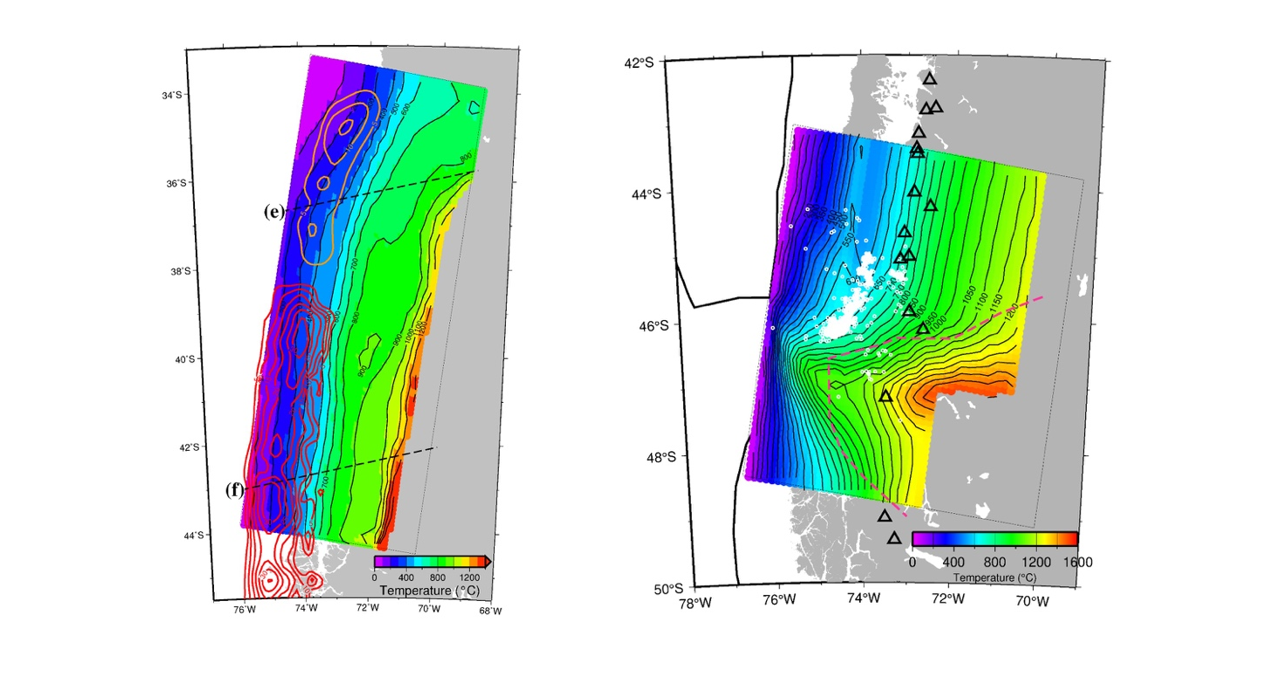
We construct a heat-flow-calibrated 3-D model spanning the rupture areas of the 2010 Maule (Mw 8.8) and 1960 Valdivia (Mw 9.5) earthquakes and the Southern Volcanic Zone. The best-fit solution favors a very weak megathrust (small effective friction coefficient) without a rigid mantle wedge. We estimate rupture-limit temperatures along the plate interface and highlight why the downdip limit of the 1960 Valdivia event is systematically hotter, consistent with its deeper rupture and the thermal effect of a younger incoming slab. We then show that peaks in along-dip dehydration gradients—more diagnostic than water content alone—cluster beneath the arc, supporting focused fluid release that promotes mantle-wedge melting and volcanism.
(2) Chile Triple Junction (CTJ): slab window, tremors, and volcanoes
We next move to the CTJ, where ridge subduction produces a slab window and strong along-strike thermal contrasts between Nazca and Antarctic slabs. Using Curie-point depth constraints (∼550 °C isotherm) and sensitivity tests on ridge migration, shear heating, and mantle-wedge rigidity, we reproduce the slab-window thermal imprint and show that the Antarctic slab surface is hotter than the Nazca slab at equal depth. Dehydration gradients remain a plausible first-order predictor for volcanism beneath the chain, whereas the observed tremor distribution cannot be explained by dehydration alone, implying additional controls such as fluid transport pathways and/or stress conditions.
Together, these two case studies illustrate how a unified 3-D thermomechanical approach can bridge interface rupture limits, volatile release, and slab-window dynamics, providing physically grounded links between deep processes and observable seismic and volcanic patterns.
SPEAKER
 Shoichi Yoshioka is Professor of Solid Earth Geophysics at Kobe University (Research Center for Urban Safety and Security; Graduate School of Science), Japan. His primary research focuses on the physics of subduction zones, with particular emphasis on how three-dimensional thermal structure and metamorphic dehydration, quantified using layer-specific phase diagrams, control the spatial distribution and characteristics of interplate earthquakes and arc volcanism.
Using 3-D thermomechanical numerical models, he investigates the evolution of temperature, rheology, and fluid release within subducting slabs and the mantle wedge, and examines how these processes regulate megathrust rupture limits, fluid pathways, and volcanic-arc localization. A key aspect of his work is identifying along-dip dehydration gradients as physically meaningful indicators linking slab processes to observable seismic and volcanic patterns. In parallel, Prof. Yoshioka also conducts GNSS-based inversion analyses to estimate the spatiotemporal distribution of slip associated with long-term slow slip events (SSEs) and interplate coupling variations. These geodetic constraints complement his thermomechanical studies by providing independent, observation-driven insight into fault slip behavior over months to years.
Through the integration of thermal modeling, phase-equilibrium calculations, and geodetic inversion, his research aims to establish a coherent, physics-based framework for understanding subduction-zone dynamics and their implications for seismic and volcanic hazards.