


MindOpera is a comprehensive facilities information management system that enables public administrations, hospitals, universities and building managers to unify, analyse and optimise all energy and maintenance data in a single environment. This innovative tool, created by the BEE Group—the Innovation Unit in Building, Energy and Environment at CIMNE— is the core engine of Infraestructures.cat Data Orchestrator (l’Orquestrador) and of the Energy Monitoring System (SIME) of the Catalan Energy Institute of the data orchestrator of the Catalan Energy Institute (ICAEN).
More than 11,000 public facilities of the Government of Catalonia are connected to MindOpera and actively used by the technical and energy management teams of the different government departments, maintenance companies, and the technical teams of i.CAT and ICAEN.
A holistic and structured view of building performance
Public buildings host thousands of sensors: Building Management Systems (BMS), Supervisory Control and Data Acquisition (SCADA) systems, and Internet of Things (IoT) devices that are not connected but not integrated at either semantic or data storage level. Through the orchestration of highly heterogeneous data, semantic harmonisation and the application of artificial intelligence (AI) tools, the MindOpera platform overcomes this fragmentation. It establishes a holistic and structured view of information to improve energy performance and building operations.
MindOpera represents a further step towards building decarbonisation. Through energy categorisation processes, anomaly detection, predictive maintenance and control, and the definition of consumption reduction strategies, the platform enhances intelligent asset control, energy and operational efficiency, and rigorous, informed decision-making.
More than 11,000 public buildings connected
In line with their objectives of decarbonisation, efficiency and digital sovereignty, Infraestructures.cat and ICAEN have deployed two platforms for the management, operation and energy information of public buildings, both powered by MindOpera as their processing and analysis engine. MindOpera is based on an ontological data model and open, reusable AI solutions. This approach generates economies of scale, avoids dependence on commercial licences and guarantees progressive savings in the medium and long term.
MindOpera currently supports more than 11,000 public facilities, of which 2,000 are fully digitalised. These buildings comprise over 60,000 zones and 130,000 digital devices, more than one million processed work orders, and the integration of over 20,000 monitoring devices using industrial protocols such as Modbus and BACnet.
The platform directly reduces workloads associated with energy and operational building management through the automation of data collection, indicator generation and the activation of intelligent alerts. This advanced predictive control enables early detection of inefficient behaviour, prioritisation of interventions and reduction of CO₂ emissions, while optimising the distribution and use of self-generated energy and improving the response to demand peaks.
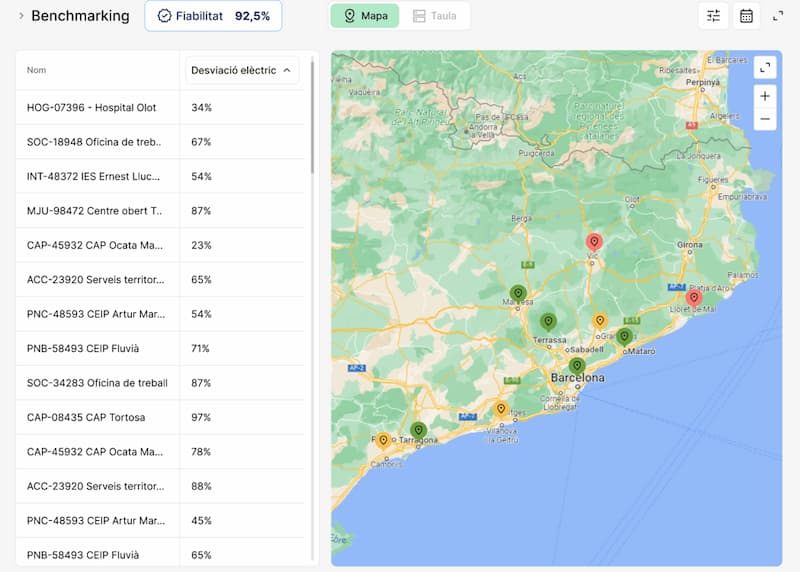
Interactive dashboard showing electrical deviation across public facilities in Catalonia.
Towards data-driven digital governance
MindOpera is built on a modular cloud architecture that combines orchestration with Kubernetes and real-time data ingestion with Kafka. This infrastructure enables the integration of heterogeneous data sources—such as consumption and temperature data, maintenance work orders, energy efficiency measures, renewable generation, cadastral information, BIM models or SCADA data—and their automatic harmonisation through a semantic graph-based structure using high-speed, scalable graph databases (Neo4j) and time-series databases (HBase and InfluxDB), which feed communication layers and visualisation tools supporting real-time decision-making.
The platform incorporates artificial intelligence (AI) modules focused on predictive maintenance, anomaly detection, and the generation of operational and comparative indicators across buildings, strengthening the capacity to interpret and monitor asset performance.
As highlighted by Jordi Cipriano, Director of the BEE Group: “the combination of interoperability, automation and advanced analytics that turns MindOpera into a strategic tool for anticipating needs, improving system reliability and maximising the overall performance of the public building stock”. The platform paves the way for new, scalable, data-driven approaches to planning, diagnostics and decision-making, aligned with the sustainability and digital transformation goals of the public sector, as a first step towards future deployment in the private commercial building sector.
BEE Group: digital and sustainable solutions
BEE Group pioneers digital and sustainable solutions for buildings and cities. Through big data, AI, and smart technologies, its tools improve energy efficiency and empower users to build energy communities resilient to climate change. You can find more information about the solutions developed by BEE Group on its website.