

ABSTRACT
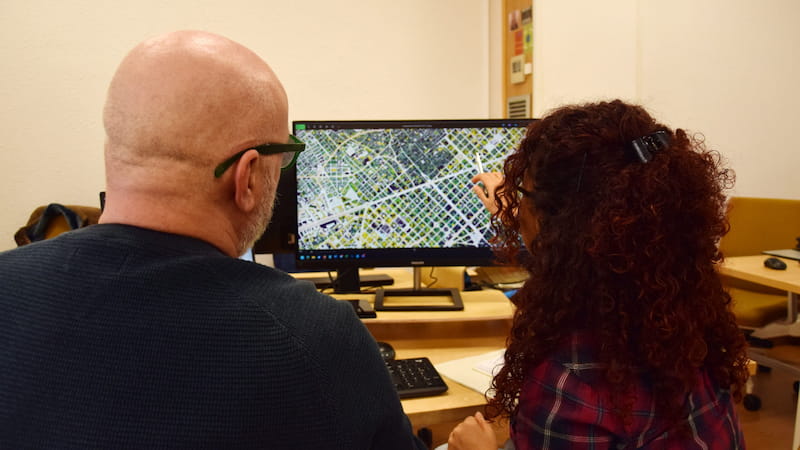
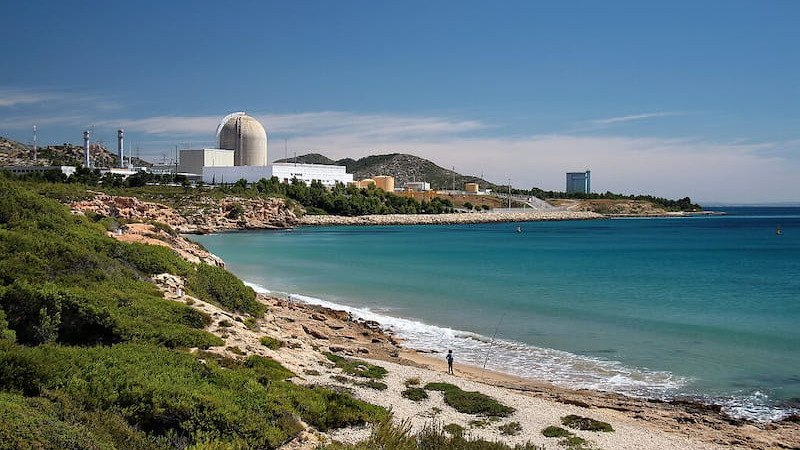
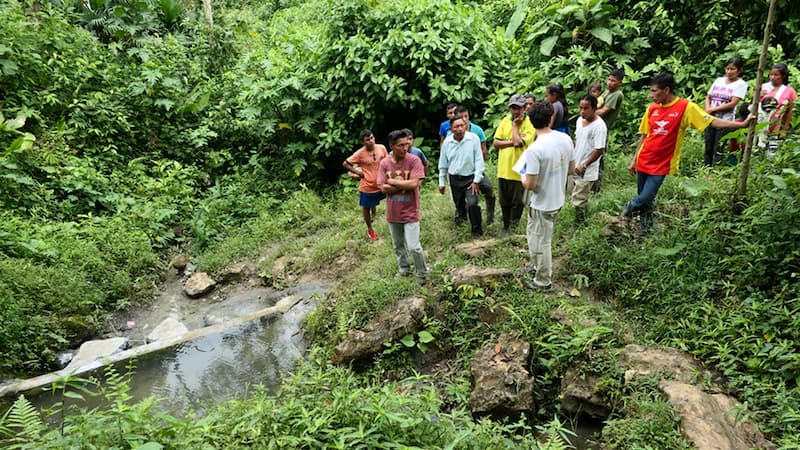
This thesis develops a numerical tool for the analysis of torrential flows in high-mountain area. The formulation is based on an Eulerian two-fluid, Newtonian incompressible approach combined with a level set method for capturing the free surface.One of the main contributions of the thesis is the improvement of the mass-preserving and energy-preserving properties of Eulerian two-fluid formulations. A consistent mass source term is added to adress the intrinsic mass losses of the level-set method, and a three-step splitting strategy is introduced to guarantee the energy-preserving properties of the numerical scheme for the coupled Navier–Stokes and free-surface convection problem.The formulation is also extended to non-Newtonian rheologies, providing the capability to reproduce the more complex flow behaviours exhibited during mass flow events. A method is proposed that adapts standard CFD boundary conditions within a two-fluid framework to hydraulic flows, allowing both supercritical and subcritical regimes to be accurately captured.A black-box tool for generating three-dimensional terrain meshes is also developed, producing geometries derived from real terrain data and enabling its application to mass flow hazard scenarios.The proposed framework is validated through theoretical, experimental, and real-scale cases. Among these cases, the glacier–rock collapse in Chamoli (India, 2021) is especially significant, as it demonstrates the capability of the developed tool to reproduce a large scale torrential event and confirms its suitability for high mountain mass flow hazard analysis.
PhD Advisors:
- Riccardo Rossi Bernocoli
- Rubén Zorrilla Martínez
PHD CANDIDATE
 Uxue Chasco is a PhD candidate working with the Kratos Multiphysics Group at CIMNE, part of the Large Scale Multiphysics Computations research cluster. Her research focuses on developing advanced numerical tools for the 3D simulation of high mountain torrent flows, specifically addressing mass and energy conservation in two-fluid formulations.