



On November 18th 2020, Pere-Andreu Ubach has successfully defended his PhD Thesis entitled: “BEST: Bézier-Enhanced Shell Triangle. A new rotation-free thin shell finite element”. The thesis has been developed in the framework of the PhD Programme in Structural Analysis of the Technical University of Catalonia (UPC · Barcelona Tech). The thesis supervisors have been the UPC professors Eugenio Oñate and Julio García-Espinosa. Due to the COVID-19 restrictions, the thesis defense took place in the online mode. The thesis obtained a qualification of Excellent.
The PhD Exam Committee was formed by Professors Riccardo Rossi of UPC · Barcelona Tech (Chair), Roland Wüchner (Braunschweig University, Germany) and Carlos Lázaro (Technical University of Valencia, Spain).
Pere-Andreu Ubach has been working as a research engineer at CIMNE during his PhD studies. During this period he has been responsible for the development of several research projects, as well as for the supervision of the construction of two CIMNE buildings at UPC.
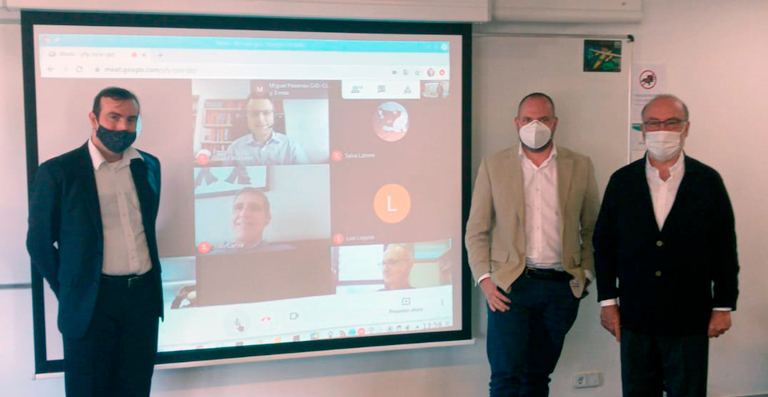
From left to right: Pere Andreu Ubach, Riccardo Rossi and Eugenio Oñate. The image projected shows Professors Julio García-Espinosa, Carlos Lázaro and Roland Wuchner during the on-line presentation.
About the thesis
A new thin shell finite element is presented. This new element has not rotational degrees of freedom. Instead, in order to overcome the C1 continuity requirement across elements, the author resorts to enhance the geometric description of the flat triangles of a mesh made out of linear triangles, by means of Bernstein polynomials and triangular Bernstein-Bézier patches.
In order to use them to define the Bernstein-Bézier patches. Ubach, Estruch and García-Espinosa performed a comprehensive statistical comparison of different weighting factors. They find a new weighting factor, wich reduces by about 10% the root mean square error in the estimation of normals of randomly generated surfaces with respect to the previous best weighting factor found in the literature.
A new paradigm is presented consisting on the reconstruction of the geometry of a cubic triangular element. This geometric reconstruction exploits the properties of cubic B-spline functions (cubic Bézier triangle). This way, the author builds a conforming continuum-based shell finite element.
The only degrees of freedom of the BEST element are the vertices’ coordinates (9 variables). The remaining 21 parameters are solved internally, introducing energy minimization considerations. In order to fix the values of these 21 internal parameters, each BEST element solves 9 systems of linear equations of rank 3.
The BEST element is successfully applied to the analysis of thin shells in linear and geometrically non-linear regimes using an implicit method. The non-linearity is solved using a Total Lagrangian formulation. The author succeeds at pre-integrating through-the-thickness efficiently and accurately.
The numerical examples results show that the BEST element has the potential to achieve cubic convergence. For membrane oriented tests with curvature, the convergence is quadratic.