

ABSTRACT
Most techniques employed to solve partial differential equations need to generate a mesh that describes the geometry of the model. Although unstructured mesh technology has advanced dramatically and it is now possible to produce three-dimensional meshes with hundreds of millions of elements within minute, the demands of modern design optimisation expose a critical limitation. Industrial workflows routinely require thousands of simulations across varying operating conditions and geometric configurations. Producing an appropriate mesh for each case becomes prohibitively time-consuming, largely due to the level of human expertise and manual intervention involved. As a result, industry often resorts to overly refined, one-size-fits-all meshes, increasing computational cost and amplifying the carbon footprint associated with large-scale HPC usage.
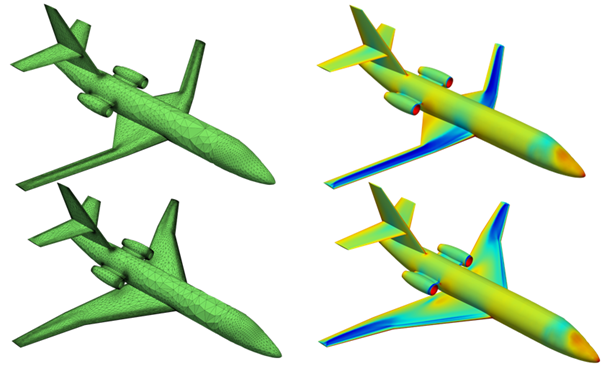
This talk will introduce a new AI-driven framework for predicting near-optimal meshes tailored to each simulation. The approach leverages the vast amount of data already available in industry to infer suitable isotropic and anisotropic spacing functions, effectively transferring knowledge from past analyses to guide the mesh generation process. By integrating AI into this key stage of the workflow, the methodology seeks to deliver accuracy comparable to expert-crafted meshes while reducing the need for manual tuning, enhancing automation, and lowering energy consumption.
SPEAKER
 Rubén Sevilla is a Professor of Computational Engineering at the Zienkiewicz Institute for Modelling, Data and AI in Swansea University (UK). He obtained his PhD in Applied Mathematics from the Universitat Politècnica de Catalunya (Spain) in 2009. His work on NURBS-enhanced finite element methods, with by Prof Antonio Huerta and Prof Sonia Fernández-Méndez, received several awards, including the ECCOMAS Best PhD Thesis Award.
His research focuses on advancing computational engineering through high-order numerical methods, robust mesh generation, and precise geometric representation. He has made contributions to curved and CAD-aware mesh generation, enabling accurate simulations on complex domains without physics-dependent de-featuring. More recently, he has developed machine-learning approaches to accelerate mesh generation and adaptation, improving automation in CFD simulation pipelines. Across these themes, his research aims to create reliable, efficient, and geometry-faithful tools that support next-generation engineering design and analysis.
Rubén combines his passion for research with a genuine commitment to training the next generation of computational engineers, while also serving the community through his involvement in UKACM, ECCOMAS, and IACM.