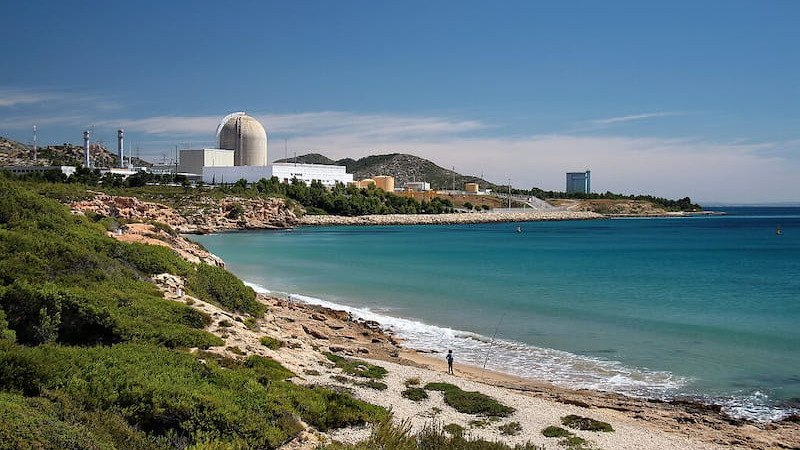

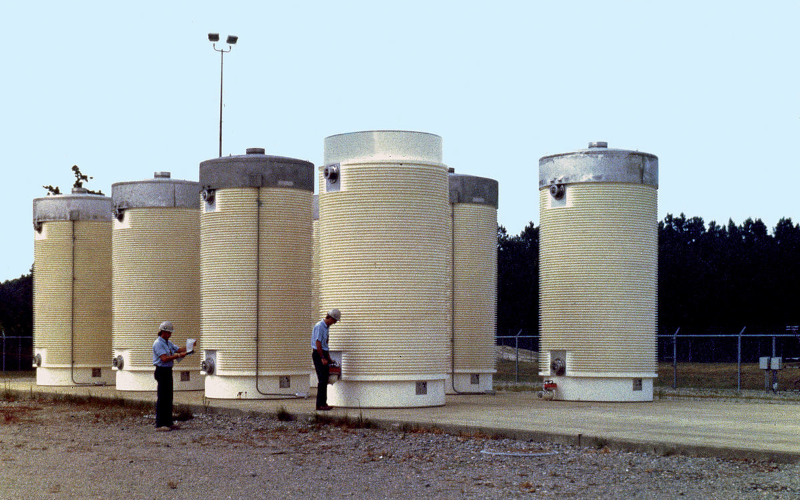
Temporary storage of radioactive waste prior to deep geological disposal.
Electricity today accounts for nearly 40% of global greenhouse gas emissions, according to the International Energy Agency (IEA). Countries such as France, Sweden, Finland and Canada have firmly embraced nuclear energy — free of CO₂ during its generation — to decarbonise the energy system.
Deep geological disposal is currently the most widely accepted solution among the scientific community and state bodies for managing high- and intermediate-level, long-lived radioactive waste, due to the long-term isolation and safety it provides.. The International Centre for Numerical Methods in Engineering (CIMNE) is taking part in an ambitious international research project, DECOVALEX, contributing its expertise in advanced computational models to improve understanding of these systems’ long-term behaviour..
Numerical methods to ensure the structure of nuclear repositories
Numerical methods have proven useful for addressing complex physicochemical processes, making them a promising tool. Accurately simulating geological behaviour is critical not only for repository design, but also for the management and monitoring of the assets. While full-scale experiments have inherent limitations and high costs, advanced simulations are valuable for analysing the characteristics and evolution of the geological formations that make up the repositories.
With a track record of more than 30 years, DECOVALEX (Development of Coupled Models and their Validation against Experiments)is a collaborative project bringing together research groups with the support of state agencies and radioactive-waste management organisations. It aims to understand physicochemical processes in geological repositories and translate them into numerical models. CIMNE’s participation began, funded by ENRESA (Empresa Nacional de Residuos Radiactivos S.A), in the 1999–2003 edition. CIMNE has continued to take part from 2008 to the present, currently funded by ENRESA and ANDRA (Agence nationale pour la gestion des déchets radioactifs).
Two years ago, the sub-edition DECOVALEX-23 (2020-2023) concluded, addressing a wide range of issues related to the behaviour of natural or engineered structures of clay and crystalline rocks. It focused particularly on roca argilosa Callovo-Oxfordian, a widely studied geological formation chosen in France for waste disposal and considered a candidate elsewhere in Europe.
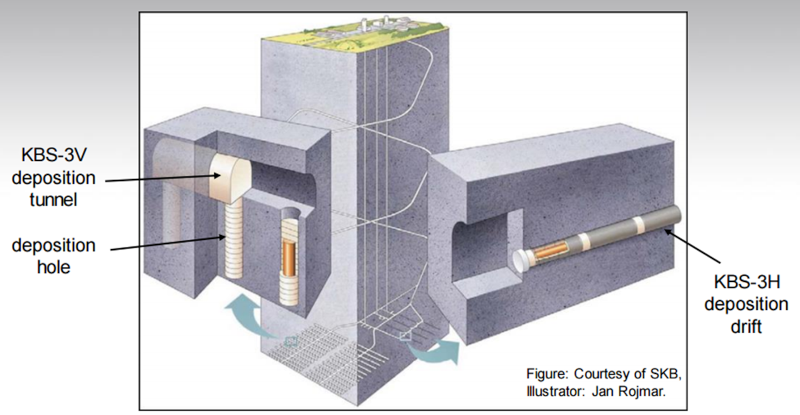
Diagram of a deep geological repository for high-level nuclear waste showing two different systems: the KBS-3V system, with vertical placement of canisters, and the KBS-3H system, with horizontal placement.
Temperature as a threat
The basic physicochemical factors are the first to threaten the integrity of nuclear repositories and potentially affect their safety. Temperature (T), humidity (H) and mechanical stresses (M) are the main actors and interact in complex ways through what is known as THM behaviour (Thermo-Hydro-Mechanical). Hydromechanical effects have been studied in detail through in situ tests and numerical studies, leaving aside the effect of temperature. Although this effect may not seem obvious, high-level nuclear waste releases large amounts of heat that decisively influence the surrounding structure. An increase in temperature can generate internal pressures within the rock due to the uneven expansion of water and minerals, causing cracking.
One of the proposed studies analysed the THM response of repositories containing high-level waste at real scale. The models considered excavation, repository installation and long-term operation, and successfully reproduced the initial geological conditions. The simulations involving CIMNE confirm that the large amounts of heat significantly increase pore pressure, weakening the rock structure, already damaged by excavation. They also show that the spacing between the micro-tunnels, housing the nuclear-waste canisters is a decisive factor: spacing that is too small favours stress concentration and the formation of damaged zones, although these do not propagate into the intact rock.
Gas release and cracking of the structure
Fractures in the structure resulting from high pressure are not exclusive to the behaviour described above. Corrosion or degradation of metals, especially in the case of high-level, long-lived radioactive waste, causes gas release,usually hydrogen, which over the long term also increases internal pressure.
Another line of the project has addressed the impact of pressure and gas release and has calculated the threshold pressureat which the rock becomes damaged. Obtaining these parameters is essential so that the design of radioactive-waste repositories facilitates gas movement through the structure and prevents damage. The team has simulated high-pressure conditions that lead to rock cracking and, despite current limitations of the results, the models can predict under which conditions cracks form and what should be controlled to avoid them.
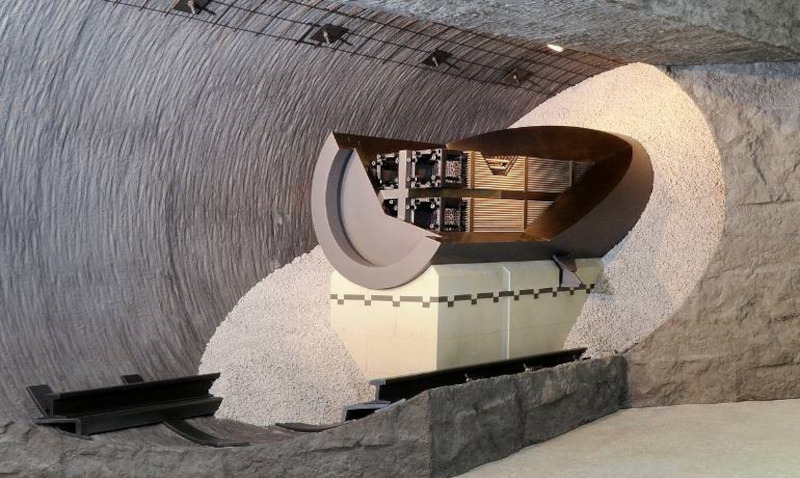
Diagram of a radioactive-waste canister in a deep geological repository, surrounded by claystone.
From laboratory to screen: refining numerical models
Within the project, a pioneering laboratory-scale experiment has been carried out simulating the conditions of a geological repository with high-level waste at the Äspö Hard Rock laboratory in Sweden. This experiment has reproduced the THM effects in a representative claystone sample and has monitored possible crack formation.
The data obtained are extremely valuable and demonstrate the potential of numerical models: only minor adjustments were required to reproduce key phenomena, even at large scale. Nevertheless, simulations still need laboratory data for initial calibration and, together with the complexity of the physical processes, this constrains the predictive capability of the tool.
CIMNE’s role in long-term safety
These examples of work highlight the relevance of numerical methods in contexts where effects unfold over the long term or experimentation is logistically and/or economically costly. The research staff of CIMNE’s Geomechanics and Hydrogeology cluster have contributed to this project since 2008 as a reference centre for numerical methods in engineering and remain involved in the new DECOVALEX-27 edition (2024-2027), which aims to overcome limitations of these models and address new technical challenges. The Geomechanics group at CIMNE works to deepen understanding of geological behaviour and has developed computational tools that are benchmarks in the analysis of various physical processes applied to the study and design of underground structures.
Thanks to international research, the expertise of the researchers and a multidisciplinary approach, the DECOVALEX project remains a benchmark for improving esilience in nuclear-waste storage and ensuring its long-term safety. Numerical methods are a versatile and effective tool for testing the design of these systems and improving understanding of the complex processes that take place within them.
[1] Fei, S., Gens, A. Collico, S., Plúa, C., Armand, G., & Huaning, W. (2025). Analysis of short- and long-term coupled THM behaviours in argillaceous rock for nuclear waste disposal. Geomechanics for Energy and the Environment, 42, 100660. https://doi.org/10.1016/j.gete.2025.100660
[2] Plúa, C., de La Vaissière, R., Armand, G., Olivella, S., Rodríguez-Dono, A., Yu, Z., Shao, J.-f., Radeisen, E., & Shao, H. (2025). Numerical investigation of the gas-induced fracturing behavior of the Callovo-Oxfordian claystone. Geomechanics for Energy and the Environment, 27, 100669. https://doi.org/10.1016/j.gete.2025.100669
[3] Tamayo-Mas, E., Harrington, J. F., Damians, I. P., Kim, J. T., Radeisen, E., Rutqvist, J., Lee, C., Noghretab, B. S., & Cuss, R. J. (2025). A comparative analysis of numerical approaches for the description of gas flow in clay-based repository systems: From a laboratory to a large-scale gas injection test. Geomechanics for Energy and the Environment, 42, 100654. https://doi.org/10.1016/j.gete.2025.100654