
A group of researchers from the International Centre of Numerical Methods in Engineering (CIMNE) have proposed a new methodology for improving Machine Learning-based model forecasting of gound-level ozone (O3), a pollutant of photochemical origin that affects territories with high exposure to solar radiation, such as the Mediterranean Basin.
In a paper for the Atmospheric Pollution Research journal, David J. Vicente and colleagues compared different Machine Learning based models and presented a method to improve their forecasting ability of daily maximum 8-h average ozone (O3,MDA8). The authors applied two variants of the Random Forest algorithm to 1-day time horizon predictive models for the Plain of Vic (Plana de Vic) in Catalonia, Spain, using datasets from 2002 to 2020.
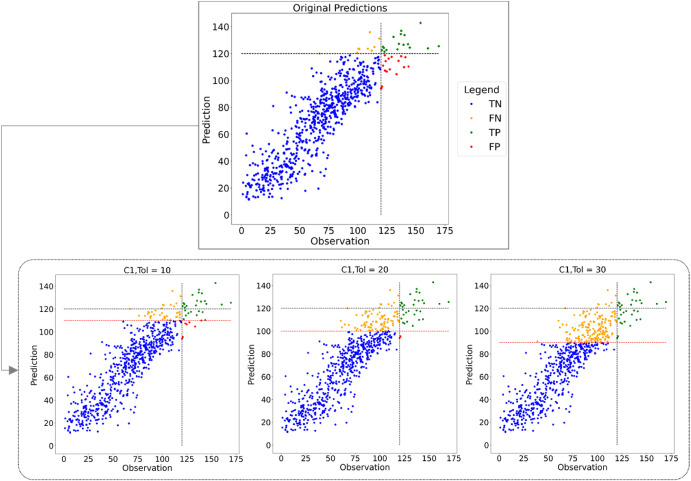
Example of the BReg approach: Original class predictions with the AReg method (upper plot) and new results for an increasing value of C1,Tol (lower plots).
Machine learning based models can identify complex relationships between ozone levels and relevant variables, but those used until now fell short in predicting extreme events. The novel methodology presented in this paper provided better results in balancing classification metrics and increased the proportion of correct predictions in the higher ranges of O3.
The area studied by the researchers from CIMNE and the University of Barcelona, the Plain of Vic, has the highest number of historical episodes of excess O3, as directed by Catalan environmental legislation, due to its particular orography, climatology, population, and industrial and livestock activity. The plain of Vic is a flat depression 60 km (37 mi) north of Barcelona, surrounded by a mountain system, and suffers from regular climatological situations of deficient atmospheric ventilation.
According to Dr. David J. Vicente and Dr. Fernando Salazar, members of the Machine Learning in Civil Engineering research group at CIMNE and co-authors of the study, the proposed methodology allows for “a better prediction of high pollution episodes”and has the potential to “improve the quality of life” in an area suffering from a “chronic poor environmental quality.”
This research was developed within the PIKSEL project, Portal for the integration of knowledge for sustainable ecosystems and land management, funded by the Department of Territory and Sustainability and the Department of Climate Action of the Catalan Government. PIKSEL is a management and forecasting tool to study environmental, demographic, economic, and social phenomena in Catalonia to support data-based decision-making.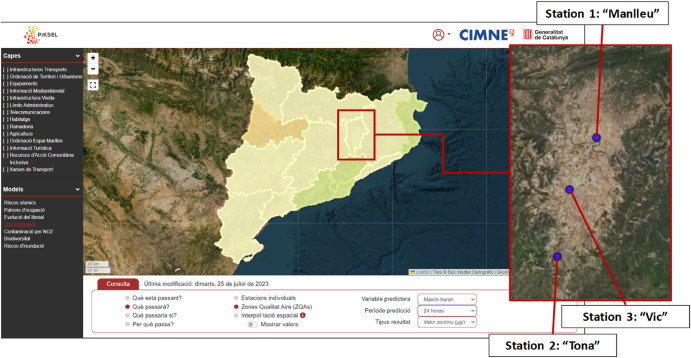
Screenshot of the “Piksel” platform. Catalonia region disaggregated into ZQAs (left) and detail of the orographic plain of VIC with the specific location of the three air-quality monitoring stations considered in this work (right).
The paper, entitled Evaluation of different machine learning approaches for predicting high concentration episodes of ground-level ozone: A case study in Catalonia, Spain will be published in the March 2024 edition of the Atmospheric Pollution Research journal and is available online for a fee.
Cover photo: Arnaucc, Wikimedia Commons