
ABSTRACT
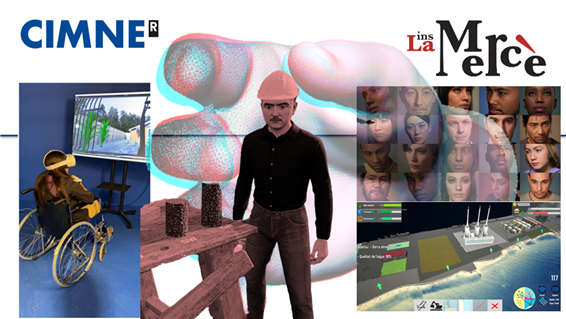
This talk presents three projects developed by students on the Advanced Course in 3D Animation, Games and Interactive Environments at IES La Mercè during their work placements at CIMNE, aimed at exploring the application of video game and animation technologies to the school’s projects and initiatives.
The first part of the talk will be devoted to presenting the following areas of work:
NPC2NPC. Social interaction between digital humans in virtual reality.
Presented by Arnau Bes
This presentation showcases tests conducted on dynamic conversation between non-playable characters (NPCs) in Unreal Engine using Convai and Metahumans technology. We will analyse how to break down the barrier of ‘Player-NPC’ interaction to enable AI agents to converse autonomously with one another using proxy logic and virtual microphones. In addition, the workflow for creating hyper-realistic avatars using Reality Scan and the integration of professional animations with Mixamo is presented, focusing on how these technologies enhance the sense of ‘social presence’ in virtual environments, whilst also incorporating personality and behavioural profiles for each digital human.
Video games as a tool for designing a more accessible virtual reality.
Presented by Irene Benito
Virtual reality, alongside video game engines, immersive environments and digital twins, is a technology that has reached a level of technical maturity capable of simulating realities with astonishing accuracy. However, when observing end-user interaction with these tools, we often perceive a significant gap: interfaces are often rigid, complex or unintuitive, straying from the principles of universal accessibility that should govern any technological advancement.
Paradoxically, the video game industry has been solving this problem out of necessity for decades. For a game to be successful, it must be able to teach its rules organically and without manuals to a global and diverse audience. In the field of cognitive accessibility, video game design offers an unrivalled testing ground. Whilst in conventional software development accessibility is usually added as a final layer, in game design it is integrated into the core of the experience through visual reinforcement, immediate feedback and passive guidance.
This session will present the process of redesigning the user interface and user experience (UI/UX) for the ARCO-VR project, developed in Unreal Engine 5. Drawing on experience gained in the gaming sector, we will explain how game mechanics—such as the design of immersive tutorials and mission systems using pictograms—have been implemented to transform an accessible housing simulation into a more intuitive environment. The aim is to demonstrate that true innovation in VR lies not only in its graphical power, but in its ability to be understood and used by anyone.
Animation technologies for visualising coastal dynamics
Presented by Eduardo Cruzado
This third section will demonstrate how to use video game technologies to create animations. Research findings on the modelling of beach geometry have already been applied in a previous project to develop a video game. In this new phase, animation techniques will be used to create a narrative with explanatory audiovisual material on the solution of inflatable breakwaters as a response to the challenges associated with sand loss and coastal degradation.
The second part of the session will consist of a brief presentation outlining the research framework for this work, developed at CIMNE in collaboration with Dr Felipe Muñoz of the PUCV, who will be giving the presentation. “Bringing ‘Human-centric’ Back to Digital Developments in the Age of AI”, focusing on work on extended reality (XR) and video game technologies for the construction sector.
The third part of the session will be devoted to a discussion among attendees, to explore in greater detail the tools used, expectations and possible applications in other areas of the centre’s work.
SPEAKERS
 Irene Benito is a student on the Advanced Course in 3D Animation, Games and Interactive Environments at IES La Mercè and is currently undertaking her work placement at the International Centre for Numerical Methods in Engineering (CIMNE). Her work focuses on redesigning the user interface and user experience (UI/UX) for the ARCO-VR virtual reality project, developed in Unreal Engine 5. Her work involves applying design principles and mechanics from the video game industry to identify and remove barriers to cognitive accessibility, thereby facilitating a more intuitive and autonomous interaction for all types of users in virtual environments.
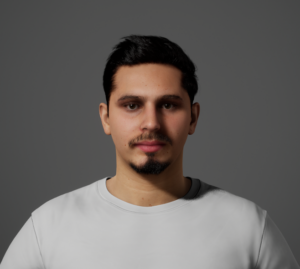 Arnau Bes. Student on the Higher Level Vocational Training (FP) course in 3D Animation, Games and Interactive Environments. He is currently undertaking an internship at CIMNE, where he specialises in the development of virtual environments, interactive technologies, the integration of conversational AI, and the creation of digital humans (Metahumans) to enhance immersion in the centre’s virtual reality projects.
 Eduardo Cruzado is a student on the Advanced Course in 3D Animation, Games and Interactive Environments at IES La Mercè and is currently undertaking an internship at the International Centre for Numerical Methods in Engineering (CIMNE). He has experience working in organised teams (production control room and stage management). He is currently focused on content development as a 3D artist and in VFX/physics simulation.
 PhD candidate Mathias Proboste Martínez, a civil engineer from the Pontifical Catholic University of Valparaíso, Chile (PUCV), and a PhD student at UPC/CIMNE. He specialises in the application of extended reality (Virtual Reality) and artificial intelligence (AI, LLMs) to remote inspection operations in civil engineering.
 Dr Fernando Rastellini Canela. Senior Researcher at CIMNE, Associate Professor at the UPC and Business Developer at COMPASSIS. He works in computational mechanics for industry, particularly in the advanced simulation of unique buildings for seismic analysis.
 Dr Pere-Andreu Ubach. Researcher in the Structural Mechanics group at CIMNE. Member of the PIKSEL project coordination team and leader of Challenge 2 on predicting coastal evolution. He is currently working on projects aligned with the European Commission’s (EC) Destination Earth initiative.
 Dr Felipe Muñoz. Lecturer at the Pontifical Catholic University of Valparaíso (PUCV), Chile, and holder of a PhD from the UPC (2023). Expert in digitalisation for the architecture, engineering and construction sector, including emerging technologies and methodologies such as BIM, Lean Construction, UAVs and immersive applications.
 Dr Javier Mora. Telecommunications Engineer and Senior Researcher at CIMNE. He is currently working in the field of extended reality for engineering.