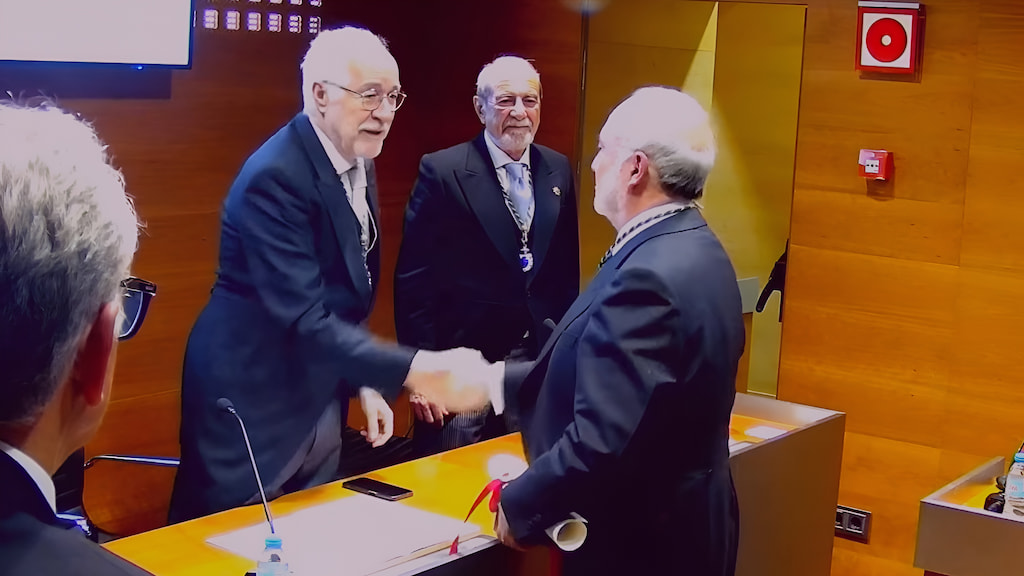
Prof. Eugenio Oñate shakes hands with a representative of the Spanish Royal Academy of Engineering after his induction as a full member, during the formal ceremony held in Madrid on 19 May.
CIMNE’s founding director, Professor Eugenio Oñate, was formally inducted on Tuesday, May 19, 2026 as a full member of the Spanish Royal Academy of Engineering (Real Academia de Ingeniería). Professor Oñate, who was elected during the Academy’s plenary session in November, delivered his acceptance speech at a formal ceremony in Madrid, in which CIMNE’s Professor Antonio Huerta gave the response address as a full member of the Academy.
In his speech, titled “An ode to Mechanics” (Elogio de la mecánica), Dr. Oñate highlighted the central role of mechanics in the development of engineering and applied science. Framing the discipline as a foundation of technical and human knowledge, he traced its historical evolution from early practical applications to theoretical mechanics, numerical methods, and contemporary computational mechanics.
During the address (see video below), Oñate emphasized the relationship between mechanics, calculation, and the capacity to model physical reality. The professor argued that progress in engineering has depended not only on understanding the laws governing natural and technological systems, but also on developing methods capable of solving the equations that describe them. In this regard, the speech linked the long history of mechanics with present-day challenges in simulation, data-driven modelling, artificial intelligence and emerging forms of computation.
A leading voice in Numerical Methods
Oñate (València, 1953) is a leading academic voice in the field of numerical methods in engineering and their practical applications. As a Civil Engineer, he founded the International Centre for Numerical Methods in Engineering (CIMNE) in 1987 in Barcelona, serving as the director of the institution until 2022.
His research focuses on advanced finite element formulations, hybrid particle‑ and discrete‑element techniques, stabilized methods for fluid and solid mechanics, computational modelling of manufacturing processes, and particle‑based simulation of melting and burning phenomena.
Professor Oñate currently serves as a Senior Distinguished Researcher within the Structural and Partical Mechanics research cluster at CIMNE.
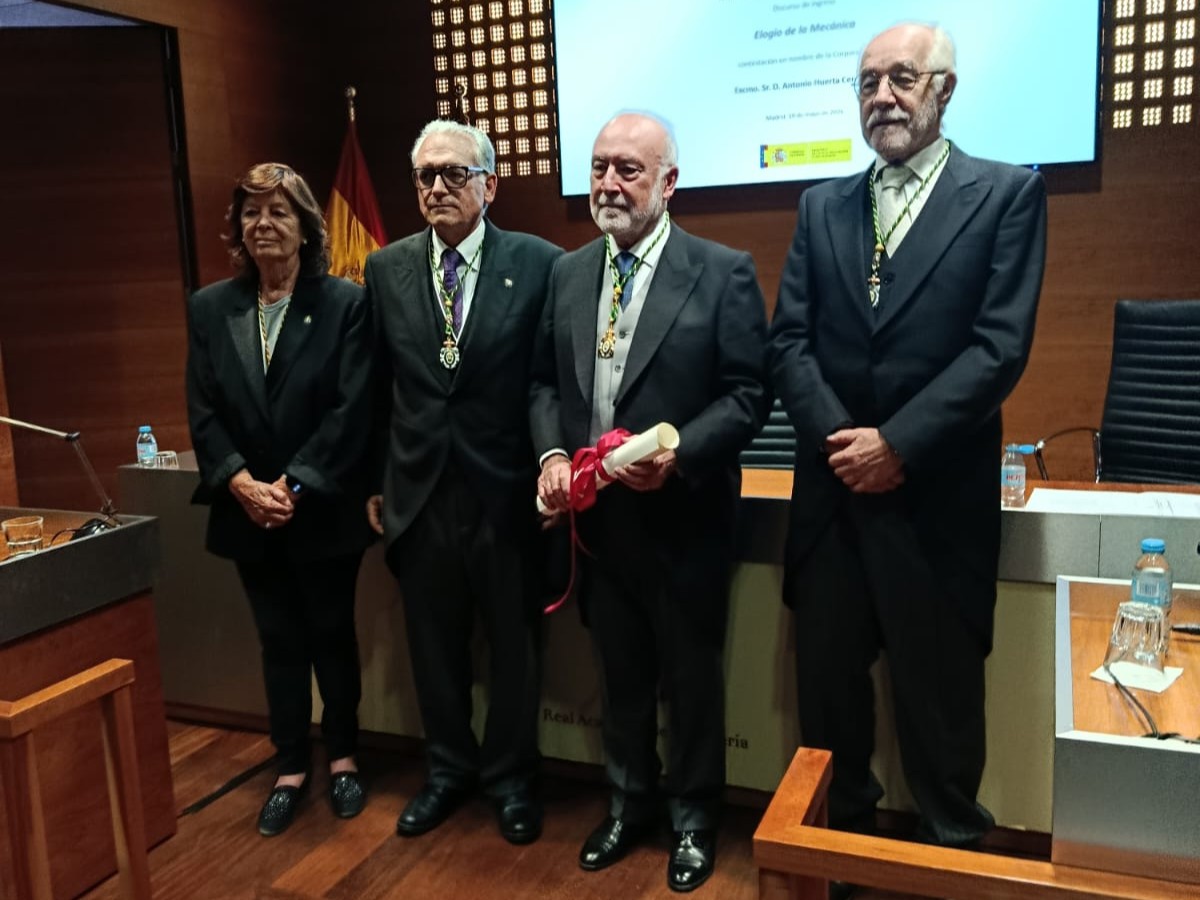
Professor Eugenio Oñate, second from right, stands with members of the Spanish Royal Academy of Engineering after his induction ceremony in Madrid, holding the formal diploma scroll.