


The ResilMob project, a pioneering initiative to bolster the resilience of geostructures in Catalonia’s Road network, is yielding its first results through a beta system placed in the mountainside of Barcelona’s Montjuïc Mountain, opposite the Ronda Litoral bell road of the Catalan Capital.
Started in 2023, this 24-month project funded by the Agency for Business Competitiveness of the Catalan Government (ACCIÓ), and with the participation of the International Centre for Numerical Methods in Engineering (CIMNE), has developed a predictive system to safeguard critical infrastructures. By integrating real-time sensor data, numerical simulations, and hybrid artificial intelligence (AIH), ResilMob will improve infrastructure maintenance and ensure safer, more reliable mobility.
Under the leadership of Mr. Oscar Frutiós, Principal Investigator from CIMNE’s Solid and Fluid Simulation for Industrial Processes research cluster, the project brought together a multidisciplinary team of CIMNE researchers, including Angel Priegue, Brain J. Ramírez, Dr. Fernando Rastellini, Dr. Alfonso Rodríguez, and Dr. Josep M. Carbonell.
Working alongside small and medium enterprises (SMEs) in civil engineering (Pigra Engineering) and advanced simulation (Quantech Atz), as well as external collaborator WorldSensing, the team has created a prototype to uphold how geostructures—such as slopes and embankments—are monitored and maintained.

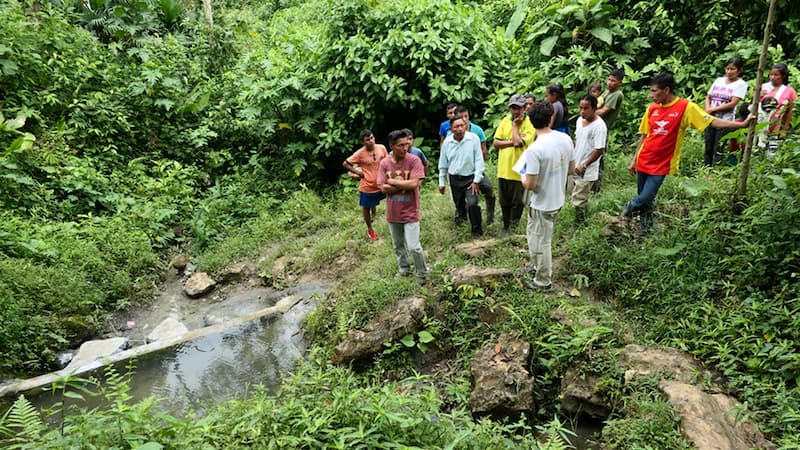
The mountainside of Montjuïc, in Barcelona, overlooking the city's port, where the sensors are installed.
Key Results Driving Resilience and Safety
The ResilMob Beta system offers real-time monitoring of critical geostructure parameters, enabling rapid decision-making during extreme weather events, a growing concern amid climate change. By combining historical incident data, in-situ sensor readings, and synthetic data from numerical simulations (based on MEF and G-PFEM models), the system’s hybrid AI module generates detailed status reports, risk alerts, and predictive maintenance recommendations. These tools aim to prevent high-risk conditions that could disrupt the mobility of people and goods, supporting both public infrastructure operators in road and rail, as well as and industries reliant on just-in-time logistics.
Experts calibrated simulation models with field data to ensure accuracy in predicting geostructure behaviour under extreme scenarios. The new system introduces risk indicators and maintenance forecasts, enhancing the capacity to adapt infrastructure to adverse conditions. This predictive approach addresses a critical gap in Catalonia’s infrastructure management, reducing the likelihood of accidents, service interruptions, or costly detours for freight and passenger transport.
A Step Forward for Quality of Life
With a total budget of €301,068.85, including €13,500 in external collaborations, ResilMob offers a tangible solution to safeguard linear infrastructure—vital for the movement of people and goods—, directly improving quality of life for local communities. Its focus on resilience mitigates the impact of climate-driven disruptions, ensuring safer roads and more efficient industrial operations, while its high level of digital integration sets a new standard for smart infrastructure management.
“The ability to predict the behaviour of geostructures, like slopes and embankments, is key to maintaining mobility and safety,» stated Mr. Fruitós. «ResilMob's Beta system is a practical tool to assist those responsible for their maintenance in making decisions to mitigate the effects of climate change,” he added.
After the initial development phase, experts say ResilMob is poised for real-world deployment and potential scaling, with applications extending beyond Catalonia to other areas facing similar infrastructure challenges, especially in those regions most affected by the impact of Climate Change.
ResilMob has been possible with a grant from ACCIÓ, the Catalan Agency for Business Competitiveness under the Nuclis R+D Empresarial 2022 call.