

Overview
Experts at CIMNE’s research group CAMMS (Composites and Advanced Materials for Multifunctional Structures) engineer sustainable solutions tailored to industrial needs. Their research tackles one of today’s major transport challenges by developing advanced lightweight structures that reduce fuel consumption and environmental impact, providing support to organisations such as the European Space Agency (ESA) and Airbus, which often cannot create such designs internally.
CAMMS advances efficient numerical methods and procedures to characterise and predict the behaviour of composites, advanced materials and large‑scale multifunctional structures. These capabilities enable rigorous analysis across the naval, offshore, aerospace, automotive and civil engineering sectors, delivering robust solutions for complex industrial problems.
Topology optimisation
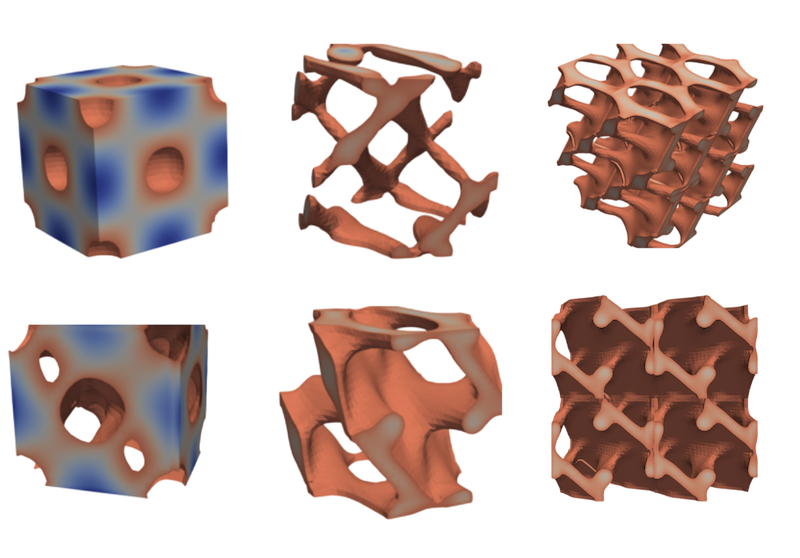
Topology optimisation is one of the most powerful techniques for lightweight structural design, enabling maximum stiffness and strength with minimum material. When combined with additive manufacturing, manufacturability constraints must be incorporated from the earliest design stages, particularly minimum feature size (length scale) and overhang limitations.
Researchers at CAMMS deliver numerical methods to globally enforce such additive manufacturing constraints, decreasing geometric complexity and promoting boundary orientations that are more suitable for vertical build directions. As a result, designs are easier to manufacture, require fewer support structures, and exhibit improved structural integrity and repeatability during printing.
TOPSAT project
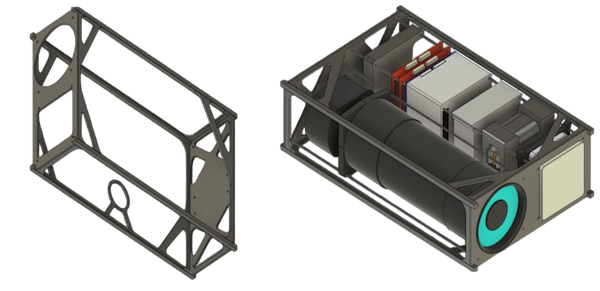
TOPSAT project (Ultra-Lightweight CubeSat Chassis Enabled by Anisotropic Topology Optimization of Composite Materials) proposes the development of a novel topology optimisation methodology to continuous-fibre composite materials to design a CubeSat chassis structure, including experimental validation. The project is led by Inegi, the Portuguese Institute of Science and Innovation in Mechanical and Industrial Engineering, in partnership with CIMNE, and funded by the European Space Agency (ESA).
The project targets significant performance improvements, with expected increases of 20–40% in stiffness and 25% in maximum load capacity compared to a composite baseline, and up to 60% mass reduction relative to conventional metallic designs. These advances enable new structural concepts and superior performance, unlocking the development of ultra-lightweight spacecraft structures.
Features

Significant mass reduction

High stiffness and load capacity

Reduced geometric complexity

Additive-manufacturing-ready geometries

Build-direction-friendly boundaries

Reduced support-material needs
Applications and Industrial Benefits

Spacecraft Structures
Ultra-lightweight chassis and structural subsystems that reduce mass and support higher payload capacity, improving mission flexibility.

Aeronautical Lightweight Components
Machine learning models trained to recognize subtle indicators of distress that may be difficult for human observers to detect.

Fuel and Emissions Reduction
Lower structural mass translates into reduced fuel consumption and environmental impact across aerospace and broader transportation applications.

Technology Transfer
Computationally efficient, manufacturability-aware methods that make advanced optimisation practical for industrial design and production workflows.
Learn More
CAMMS research
TOPSAT Project
Project Partners
Contact Us
Interested in learning more about CAMMS lightweight structures or exploring how topology optimisation can improve the performance and manufacturability of your components?
Our Technology Transfer Unit is ready to discuss your requirements and support the adaptation of these methods to your specific application, from early-stage design to validated, manufacturable solutions.